


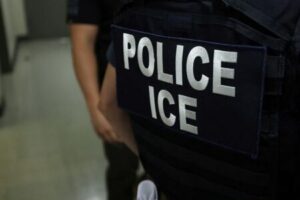























A Texas prosecutor is considering felony assault charges against a U.S. Immigration and Customs Enforcement (ICE) officer after an incident in west Houston left a 48-year-old man with multiple fractures to his leg and serious hip injuries. The case has triggered questions about the use of force by federal immigration officers, the limits of law enforcement authority, and whether federal agents should face the same legal scrutiny as other citizens when their actions potentially violate the law. In a country where officials frequently invoke law and order, the unfolding investigation presents an uncomfortable question: who holds law enforcement accountable when the law itself is allegedly put at risk?
Prosecutor Says Video Could Support Aggravated Assault Charges
Harris County District Attorney Sean Teare said footage of the Saturday morning incident appeared to show an ICE officer steering an unmarked SUV into Miguel Parra-Hernandez as he ran across an empty parking lot. Teare described the collision as an apparently intentional act and said other investigators who had reviewed the footage shared his concerns. His office is considering a possible charge of aggravated assault with a deadly weapon, an offence that could carry a prison sentence of up to 20 years upon conviction.
The injured man reportedly remained under ICE supervision at a Houston hospital, facing serious injuries and the prospect of multiple surgeries. His lawyer, Kim Bruno, said Parra-Hernandez had no criminal record and was heading to work when agents appeared in an unmarked vehicle without lights or a siren. According to his representatives, he ran because he did not know who was pursuing him. Immigration and Customs Enforcement acknowledged that he was not the intended target of the operation, although the agency said he was in the United States illegally. The distinction raises an important legal question: immigration status does not, by itself, establish that an officer was justified in using potentially dangerous force.
Texas Prosecutor Questions Immigration and Customs Enforcement Cooperation in Investigation of Man Struck During Pursuit
The Harris County District Attorney’s Office is investigating the collision alongside the county sheriff’s office. Teare said investigators sought access to the vehicle’s data recorder but encountered resistance from Immigration and Customs Enforcement. He also alleged that the officer believed to have been driving the SUV returned to the scene, entered the vehicle and drove it away while investigators were preparing a search warrant. The district attorney questioned why a vehicle potentially containing crucial evidence was not secured for forensic examination. If substantiated, the circumstances could complicate efforts to establish exactly how the collision occurred and whether the officer’s actions met legal standards.
Tears also said two people from a separate operation were believed to have been in custody inside the Immigration and Customs Enforcement vehicle when the pursuit began. His office is working to preserve their availability as material witnesses. Meanwhile, Parra-Hernandez’s lawyer and immigrant-rights advocates dispute any suggestion that he was connected to the individual ICE originally intended to apprehend.
The agency’s spokesperson rejected allegations that the man was deliberately struck, describing them as false and irresponsible, and defended Immigration and Customs Enforcement personnel as professionals expected to uphold the law. That competing account makes a thorough, evidence-based investigation essential. In a democracy, neither an official badge nor an allegation of unlawful immigration should replace evidence when questions of potential criminal conduct arise.
The case now places public confidence in law enforcement under another test. A felony charge has not been confirmed, and the officer’s guilt has not been established; the prosecutor must assess the evidence before deciding how to proceed. The satirical irony is difficult to ignore: an agency tasked with enforcing the law is facing questions about whether one of its officers may have crossed a legal line. As investigators examine the video, vehicle data and witness accounts, readers should watch OGM News for further updates on whether the potential charges become a formal prosecution and what the evidence ultimately establishes.



Finding a reliable crypto betting site can be tricky, but this platform makes the whole...