














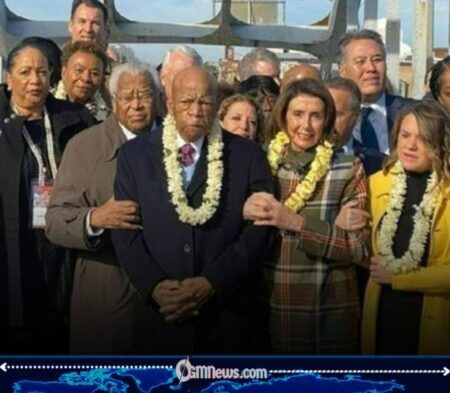
Nancy Pelosi, former Speaker of the U.S. House of Representatives has renewed her call for the passage of major electoral reform legislation, including the John R. Lewis Voting Rights Act and HR 1. Her remarks come amid continued political disagreement in Congress over voting access, redistricting standards, and federal election safeguards.
Pelosi emphasized that these bills have already passed the House of Representatives multiple times under her leadership but have repeatedly stalled in the Senate. She attributed the delays to procedural obstacles and sustained partisan division over the scope of federal election reform.
Her comments have once again placed voting rights at the centre of national political debate, highlighting the ongoing struggle between legislative progress in the House and procedural resistance in the Senate.
Renewed Advocacy for the John R. Lewis Voting Rights Act
Pelosi reiterated strong support for the John R. Lewis Voting Rights Act, describing it as a key legislative effort aimed at strengthening voter protections across the United States. The proposal seeks to reinforce federal oversight in areas where voting access has been a subject of legal and political dispute.
She noted that the bill was named in honour of the late civil rights leader John R. Lewis, whose legacy remains closely associated with voting rights advocacy. According to Pelosi, the legislation is intended to modernise protections against voter suppression and ensure equitable access to the ballot.
Despite its repeated approval in the House, the bill has not advanced through the Senate, where it has faced procedural challenges and opposition tied to the filibuster system.
HR 1 and Broader Electoral Reform Efforts
In addition to the Voting Rights Act, Pelosi highlighted HR 1, a comprehensive electoral reform package designed to expand voting access and introduce standardized redistricting rules. The legislation also includes measures related to campaign finance transparency and election security.
She stressed that HR 1 represents a broader attempt to modernise electoral systems and reduce partisan influence in the drawing of electoral boundaries. Supporters of the bill argue that it would create more consistent national standards for elections.
However, like the Voting Rights Act, HR 1 has repeatedly passed in the House but has struggled to gain traction in the Senate, where disagreements over federal authority and states’ rights remain central points of contention.
Criticism of Legislative Gridlock in the Senate
Pelosi expressed concern over what she described as repeated Senate obstruction of voting reform legislation. She pointed to the use of the filibuster as a key procedural barrier preventing the advancement of bills that have already cleared the House.
According to her remarks, this pattern of legislative delay has created a significant gap between House approval and Senate action on key democratic reforms. She argued that such delays undermine efforts to implement nationwide electoral standards.
The Senate, however, remains divided on how voting legislation should be structured, with ongoing debates over the balance between federal oversight and state control of elections.
House Passage Versus Senate Stalemate
Pelosi underscored that both the John R. Lewis Voting Rights Act and HR 1 have passed the House of Representatives multiple times under Democratic control. She presented this as evidence of sustained legislative support for electoral reform within the lower chamber.
Despite this, the Senate has not moved forward with comparable versions of the legislation, leading to repeated legislative impasses. This divide has become a defining feature of the broader debate over voting rights reform in recent years.
Analysts note that such gridlock reflects deeper partisan divisions in Congress, particularly on issues related to election law, voter access, and federal versus state authority.
Calls for Continued Legislative Efforts
Pelosi concluded by urging continued efforts to advance voting rights and electoral reform measures, emphasising their importance for democratic governance. She reaffirmed that these issues remain central to ongoing policy discussions in Washington.
She called for renewed political focus on resolving legislative differences in order to move the proposals forward. According to her position, sustained pressure from lawmakers and the public will be necessary to overcome procedural barriers.
As debates continue, the future of both HR 1 and the John R. Lewis Voting Rights Act remains uncertain, with their advancement depending heavily on Senate negotiations and broader political consensus.
Logging in is a breeze and the site stability is amazing even during peak hours....