


























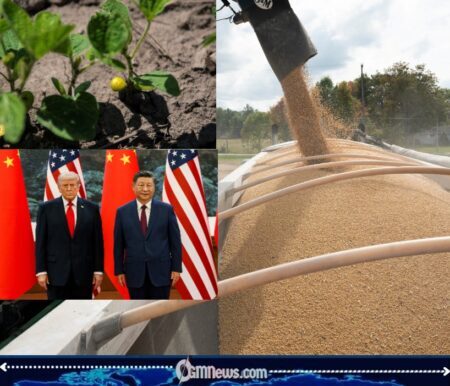
The Soybeans debate returned to the national spotlight after President Donald J. Trump announced that China would purchase billions of dollars in American agricultural products following his summit with Chinese President Xi Jinping in Beijing. While the White House celebrated the talks as a major breakthrough, farmers across Iowa responded with cautious optimism mixed with deep skepticism, reflecting years of economic strain caused by tariffs, volatile export markets, and rising operational costs. For many producers, the issue is no longer whether promises are made, but whether those promises survive long enough to reach the grain silos of rural America.
Trump Says China Will Buy Billions in Soybeans as Farmers Seek Clarity
In Harlan, Iowa, soybean farmer Rick Chipman said his crops are off to a promising start, but financial uncertainty continues to overshadow the growing season. Chipman, who operates nearly 1,800 acres alongside a hog operation in Shelby County, explained that livestock income helped offset losses caused by earlier rounds of the Trade War between Washington and Beijing. Soybean prices remain significantly below their 2022 highs, leaving many farmers dependent on export recovery to stabilize their businesses.
President Trump told reporters that “great trade deals” had been reached during the China summit and insisted that farmers would soon benefit from large soybean purchases. However, markets reacted nervously because Chinese officials did not publicly confirm specific purchase volumes or timelines. Farmers noted that they have experienced similar optimism before, only to watch negotiations slow down while commodity prices continued falling.
The Trade War has also collided with wider global instability. The ongoing conflict involving Iran has reportedly increased diesel prices sharply, adding further pressure to farm operations already struggling with higher fertilizer and seed costs. Iowa farmer Clay Geyer described planting season as financially exhausting, joking that every equipment refill now sounds like an auctioneer rapidly calling out rising prices. Behind the humor, however, lies a growing concern that smaller farms may not survive another prolonged period of uncertainty.
Soybeans Waiting for China Deal Like Fans Waiting for Concert Tickets
Recent reports indicate that discussions between Washington and Beijing may eventually lead to reduced tariffs and expanded access for U.S. agricultural exports. Chinese officials reportedly signaled openness to lowering some farm-related trade barriers after the Trump-Xi summit, while U.S. officials projected “double-digit billions” in agricultural purchases over the coming years.
Yet several analysts remain cautious because China’s dependence on American Soybeans has changed dramatically since Trump’s earlier trade battles with Beijing. China has increasingly shifted toward Brazilian and South American suppliers, partly because of pricing advantages and supply stability. Market observers warn that even if agreements are announced politically, actual buying patterns may not immediately return to previous levels.
The uncertainty has created emotional fatigue across farming communities. Some producers are considering off-farm employment simply to maintain household income, while others fear another season of unstable commodity prices could accelerate bankruptcies across rural America. Critics argue that political victories announced from international summits often sound far more complete than the complicated trade realities experienced by farmers on the ground. Even supporters of President Trump admit that many growers are now demanding evidence instead of slogans.
For now, Soybeans remain both a symbol of American agricultural strength and a reminder of how deeply global politics can affect local communities. Iowa farmers continue planting with cautious hope, watching not just the weather, but also every diplomatic signal coming out of Beijing and Washington. OGM News will continue monitoring whether the promised trade breakthroughs eventually materialize into contracts, exports, and real financial relief for America’s struggling farm belt.


[…] […]