


























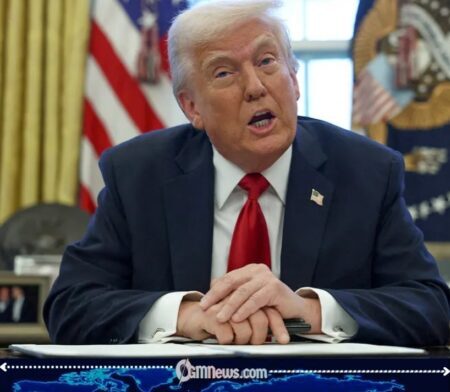
U.S. President Donald Trump has agreed to a temporary, two-week ceasefire with Iran, stepping back from the brink of a major military escalation that had threatened to engulf the Middle East. The announcement, made shortly before a self-imposed deadline for Iran to comply with U.S. demands or face extensive airstrikes, marks a critical pause in a conflict that has intensified over the past six weeks.
The ceasefire, described by the president Trump as a “double-sided” arrangement, comes amid mounting diplomatic pressure and growing global concern over disruptions to energy supplies and regional stability. While the agreement offers a window for negotiations, significant disagreements between Washington and Tehran remain unresolve Ceasefire Terms and Immediate Conditions
President Trump announced that the United States would suspend its bombing campaign against Iran for two weeks, stating that U.S. forces had already achieved key military objectives. The ceasefire, however, is conditional on Iran’s agreement to reopen the strategically vital Strait of Hormuz and ensure safe maritime passage.
Iranian Foreign Minister Seyed Abbas Araghchi confirmed that Tehran would halt what it described as “defensive operations,” including drone and missile strikes, provided the United States ceases its attacks. Iranian authorities also indicated their willingness to coordinate efforts to secure safe navigation through the Strait.
The agreement reportedly emerged following mediation efforts led by Pakistan, highlighting the role of regional actors in de-escalating tensions. The temporary nature of the truce underscores its fragility, with both sides maintaining firm conditions for continued compliance.
Role of Israel and Regional Dynamics
Israel, a key U.S. ally in the conflict, has expressed support for the ceasefire initiative. However, Prime Minister Benjamin Netanyahu clarified that the agreement does not extend to Israel’s ongoing hostilities with Hezbollah, the Iran-backed militant group based in Lebanon.
The exclusion of Hezbollah from the ceasefire framework raises concerns about continued violence in the region, even as direct U.S.-Iran hostilities pause. Analysts note that the broader conflict involves multiple actors and overlapping fronts, complicating efforts to achieve a comprehensive truce.
The war, which began with coordinated U.S. and Israeli strikes on Iranian targets in late February, has since triggered retaliatory attacks by Iran against Israel and several U.S.-aligned states in the Gulf. The ceasefire thus represents only a partial de-escalation within a wider regional confrontation.
Economic Impact and Oil Market Reaction
Global oil markets reacted sharply to news of the ceasefire, with prices dropping significantly within hours of the announcement. U.S. benchmark crude fell more than 13%, reflecting investor optimism that energy supplies could stabilize if the Strait of Hormuz reopens.
The waterway, a critical chokepoint for global oil shipments, typically carries about one-fifth of the world’s oil supply. Disruptions caused by the conflict had driven prices to multi-year highs, intensifying economic pressures worldwide.
Despite the immediate decline, oil prices remain elevated compared to pre-war levels, indicating persistent uncertainty. Market analysts caution that any breakdown in the ceasefire could quickly reverse the downward trend.
Diplomatic Efforts and Negotiation Prospects
The ceasefire follows an intense period of diplomacy involving the United States, Iran, and third-party mediators. President Trump indicated that negotiations toward a long-term peace agreement are already advanced, describing Iran’s proposed 10-point plan as a “workable basis” for further discussions.
Talks are expected to take place in Islamabad, Pakistan’s capital, over the two-week ceasefire period. Iranian officials, however, have expressed deep skepticism toward U.S. intentions, signaling that negotiations will be conducted amid significant mistrust.
The diplomatic window created by the ceasefire is seen as a crucial opportunity to prevent further escalation. However, the absence of a formal agreement at this stage leaves the process vulnerable to setbacks.
Key Disputes and Unresolved Issues
Major differences between the two sides continue to hinder progress toward a lasting settlement. Iran’s proposals reportedly include demands for a full U.S. military withdrawal from the region, the lifting of sanctions, financial compensation, and control over the Strait of Hormuz.
Such demands represent a substantial shift from current U.S. policy and are unlikely to be accepted without significant concessions from Tehran. President Trump has already indicated opposition to granting Iran control over the Strait, emphasizing U.S. strategic interests in maintaining open access.
Additionally, the future of Iran’s nuclear program remains a central point of contention. While the United States insists on a complete halt to uranium enrichment, Iran maintains that its program is peaceful and non-negotiable.
Military Escalation and Strategic Objectives
The conflict has been marked by escalating rhetoric and military action. Earlier statements from President Trump suggested the possibility of extensive strikes targeting Iran’s infrastructure, including power plants and bridges, if diplomatic efforts failed.
The U.S. administration has consistently framed its military objectives around limiting Iran’s regional influence and preventing the development of nuclear weapons. Iran, on the other hand, has positioned its actions as defensive, aimed at protecting sovereignty and supporting allied groups in the region.
The ceasefire temporarily halts these hostilities but does not alter the underlying strategic goals of either side, leaving the potential for renewed conflict.
Outlook: Fragile Pause Amid High Stakes
While the two-week ceasefire offers a momentary reprieve, its success will depend on tangible progress in negotiations. Both Washington and Tehran have signaled readiness to resume hostilities if their respective conditions are not met.
The coming days are expected to test the willingness of both sides to compromise on deeply entrenched positions. With global markets, regional stability, and diplomatic credibility at stake, the outcome of the talks in Islamabad could shape the trajectory of the conflict for months to come.


Logging in is a breeze and the site stability is amazing even during peak hours....