


























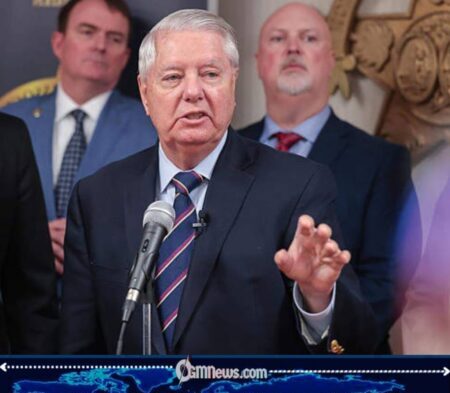
U.S. Senator Lindsey Graham is facing renewed scrutiny following his strong public advocacy for military action in Iran, alongside the circulation of footage showing him vacationing at Disney World. The contrasting images have generated widespread discussion across political and social media spaces, with critics raising questions about tone, timing, and political optics.
The situation has been amplified within conservative and MAGA-aligned circles, where some voices have expressed discomfort with Lindsey Graham’s foreign policy stance, particularly as it relates to intervention in Iran. At the same time, the emergence of vacation footage has added a layer of public perception challenges, fueling debate over how elected officials balance personal activities with serious geopolitical discourse. The development also comes amid broader discussions about U.S. foreign policy under President Donald J. Trump, who is serving a second term in office.
Graham’s Position on Iran and Foreign Policy Stance
Senator Lindsey Graham has consistently positioned himself as a strong advocate for assertive U.S. foreign policy, particularly in relation to Iran. His recent comments calling for military readiness or potential action reflect a broader geopolitical concern among some policymakers who argue that a firm stance is necessary to deter escalation in the Middle East.
These remarks come at a time when tensions involving Iran remain a sensitive international issue, with implications for regional stability and global security. Graham’s position aligns with a long-standing hawkish approach that prioritizes deterrence and military preparedness as tools of foreign policy.
However, such views are not universally accepted, even within conservative political circles. Some critics argue that calls for military intervention should be balanced with diplomatic strategies, warning that aggressive rhetoric could contribute to further instability or unintended consequences.
Emergence of Disney Vacation Footage and Public Reaction
The circulation of footage showing Lindsey Graham at Disney World introduced a contrasting narrative that quickly gained traction online. The visuals, which depict a relaxed, leisure-oriented environment, stood in sharp contrast to the seriousness of his statements regarding Iran, prompting widespread commentary.
Public reaction has been mixed, with some social media users interpreting the footage as a normal instance of personal downtime, while others viewed it as politically incongruent given the gravity of his foreign policy stance. The timing of the footage’s emergence contributed significantly to the intensity of the discourse.
Critics argue that public officials, particularly those advocating for major military decisions, are often held to a higher standard when it comes to optics and messaging. In this case, the Disney visit has been interpreted by some as undermining the seriousness of his policy advocacy, even if no direct contradiction exists between personal leisure and political positions.
Criticism from MAGA-Aligned Voices
A notable aspect of the backlash has come from MAGA-aligned commentators and grassroots supporters who have expressed concern over Lindsey Graham’s stance on Iran. Some within this group have questioned whether his advocacy aligns with the broader “America First” philosophy associated with President Donald J. Trump’s administration.
These critics argue that calls for military involvement abroad may conflict with priorities centered on domestic issues and reduced foreign entanglement. As a result, Graham’s comments have triggered internal debate within segments of the political base that typically support Republican leadership.
Despite the criticism, others within the same political sphere continue to support Graham’s position, emphasizing the need for a strong national defense posture. This divergence highlights ongoing ideological differences within the movement, particularly regarding foreign intervention and the role of U.S. military power abroad.
Optics, Timing, and Political Perception
The intersection of Graham’s Iran advocacy and his Disney vacation footage has raised broader questions about political optics and timing. In the age of digital media, public figures are increasingly subject to scrutiny not only for their policies but also for their personal appearances and activities.
Observers note that even routine personal events can become politically significant when they coincide with sensitive policy discussions. In this case, the visual contrast between a serious geopolitical stance and a leisure setting has contributed to a narrative that extends beyond the original statements themselves.
Political analysts suggest that such situations often influence public perception more than policy details, as imagery tends to resonate quickly and widely. This dynamic places additional pressure on public officials to manage both their communications and visibility carefully.
Supporters’ Defense and Clarifications
Supporters of Lindsey Graham have defended his actions, arguing that personal travel does not negate his professional responsibilities or policy positions. They emphasize that elected officials are entitled to private time and that such activities should not be conflated with their legislative or diplomatic roles.
Graham himself has indicated that his presence in Florida included meetings related to policy discussions, suggesting that the trip was not purely recreational. His defenders maintain that the Disney visit, whether personal or incidental, has been disproportionately amplified in relation to his broader work.
This perspective underscores a recurring theme in modern politics, where the boundaries between public duty and private life are increasingly blurred. As media coverage and online commentary continue to evolve, similar incidents are likely to remain a focal point of public debate.
Broader Implications for Political Communication
The episode involving Lindsey Graham highlights the growing importance of image management in political communication. In an environment shaped by social media amplification, even unrelated personal moments can become central to public narratives surrounding policy positions.
It also reflects how quickly discussions about foreign policy can intersect with cultural and entertainment content, creating hybrid narratives that attract both serious analysis and viral engagement. This blending of contexts often complicates the way messages are interpreted by different audiences.
Ultimately, the situation underscores the challenges faced by public officials operating under continuous scrutiny. As geopolitical tensions persist and domestic political dynamics evolve, the balance between advocacy, optics, and public perception will remain a critical aspect of political life.

[…] […]