





























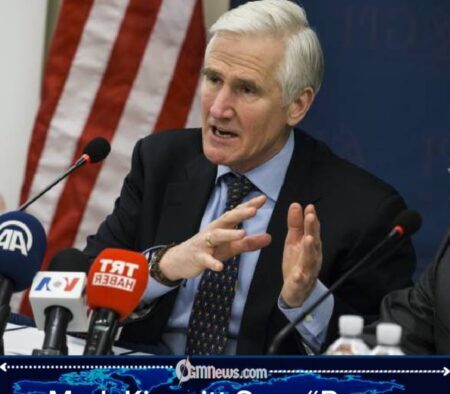
Retired U.S. Army Brigadier General Mark Kimmitt has warned that any potential American strike on Iran’s nuclear-linked power infrastructure could provoke swift retaliation and destabilize critical systems across the Gulf region. His caution highlights the growing risks tied to escalating tensions between Washington and Tehran, particularly as military options remain under discussion.
Mark Kimmitt’s remarks come at a time of heightened geopolitical sensitivity, where even limited military action could have far-reaching consequences for regional security, energy supply, and global economic stability.
Strategic Risks of Targeting Nuclear-Linked Infrastructure
Mark Kimmitt emphasized that striking infrastructure connected to Iran’s nuclear program would not be a contained or isolated action. According to him, such facilities are deeply integrated into broader national systems, meaning any attack could have cascading effects beyond its intended targets.
Mark Kimmitt noted that damage to power infrastructure could disrupt civilian life, economic activity, and regional connectivity. He warned that these ripple effects could quickly extend beyond Iran’s borders, especially in a region where energy and infrastructure networks are closely interconnected.
Retaliation Across the Gulf Region
Mark Kimmitt cautioned that Iran has both the capability and strategic intent to respond forcefully to any direct attack. He pointed to the country’s arsenal of ballistic missiles and drones, which are capable of reaching U.S. bases and allied infrastructure throughout the Gulf.
Mark Kimmitt further explained that retaliation may not be limited to military targets alone. Critical oil facilities, shipping routes, and energy infrastructure in neighboring countries could become targets, raising the risk of a broader regional confrontation that would be difficult to contain.
Limits of Defensive Systems
Mark Kimmitt acknowledged that while the United States and its allies maintain advanced missile defense systems in the region, these systems are not foolproof. He stressed that a coordinated and large-scale retaliatory strike could overwhelm existing defenses.
Mark Kimmitt warned that reliance on defensive capabilities alone may create a false sense of security. In his view, even a partially successful attack by Iran could inflict significant damage on strategic assets and disrupt regional stability.
Policy Context Under President Trump
Mark Kimmitt’s warning comes amid ongoing policy discussions under U.S. President Donald Trump, who is currently serving a second term. The administration has maintained a firm stance on Iran, including the possibility of military action if diplomatic efforts fail.
Mark Kimmitt suggested that while strong rhetoric may serve as a deterrent, it also raises the stakes of miscalculation. He emphasized the importance of balancing pressure with caution to avoid unintended escalation.
Implications for Global Energy Security
Mark Kimmitt highlighted that the Gulf region plays a central role in global energy supply, making any disruption particularly significant. He warned that attacks on infrastructure—whether in Iran or neighboring countries—could lead to sharp fluctuations in oil prices and supply chains.
Mark Kimmitt added that such instability would not be confined to the Middle East. Global markets, including those in Europe, Asia, and Africa, could feel the impact, underscoring the interconnected nature of modern energy systems.
Calls for Strategic Restraint
Mark Kimmitt concluded by urging policymakers to carefully weigh the broader consequences of military action. He argued that while addressing nuclear concerns remains a priority, the methods used must not create larger and more dangerous outcomes.
Mark Kimmitt stressed the need for diplomatic engagement alongside strategic deterrence. In his assessment, avoiding escalation is critical to maintaining stability in a region already marked by complex and longstanding tensions.


Logging in is a breeze and the site stability is amazing even during peak hours....