



























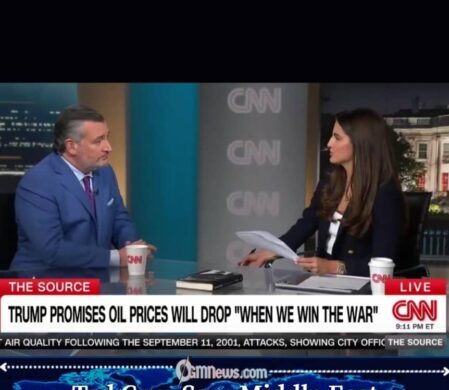
U.S. Senator Ted Cruz has warned that military conflict in the Middle East can bring a short-term shock to oil and gasoline prices, while insisting that he ultimately wants to see Americans paying “much, much lower” prices at the pump. His comments arrive as renewed fighting involving the United States and Iran continues to unsettle global energy markets, with oil prices approaching the $100-per-barrel mark and shipping through the strategically important Strait of Hormuz remaining well below normal levels.
The Pump Has Entered the Geopolitical Conversation
Cruz’s argument is straightforward: when military conflict erupts around one of the world’s most important oil-producing regions, the consequences do not politely remain on the battlefield. They can travel through shipping routes, crude markets, refineries and, eventually, straight to the fuel pump. Earlier comments by Cruz similarly acknowledged that Middle Eastern military conflict predictably creates a short-term spike in oil and gasoline prices, even as he argued that longer-term developments could push prices down.
For American motorists, however, the distinction between “short term” and “long term” can sound rather philosophical when the fuel gauge is already approaching empty. Recent market developments demonstrate the problem: U.S. gasoline prices averaged above $4 per gallon during August, while Brent crude was around $95 per barrel in early September. The Energy Information Administration has also repeatedly warned that Middle East disruptions can produce substantial volatility in petroleum prices.
Cruz Wants Lower Prices, But the Conflict Has Other Plans
The senator’s preferred destination appears clear: cheaper gasoline. The inconvenient travelling companion is geopolitics. Current fighting and reduced shipping activity around the Strait of Hormuz have raised fresh concerns about global energy supplies, with analysts watching whether the disruption becomes prolonged enough to create an even larger price shock.
President Donald J. Trump therefore faces the familiar political headache of balancing national-security decisions with the economic pain that higher fuel costs can create. Cruz has argued that a stable Iran able to return energy supplies to global markets without sanctions and conflict could eventually put downward pressure on oil and gasoline prices. In other words, Americans may have to endure the expensive chapter while politicians promise that the cheaper chapter is somewhere ahead.
For now, Cruz’s message leaves Americans with a mixture of explanation, expectation and perhaps a nervous glance at the fuel gauge: Middle East conflict can raise prices, prolonged disruption could make the situation worse, and everyone would apparently prefer much cheaper gasoline. As global markets continue to react to the conflict and the uncertain flow of oil through Hormuz, OGM News will continue watching the price at the pump—and the political arguments surrounding it—for the next twist in this increasingly expensive story.


Logging in is a breeze and the site stability is amazing even during peak hours....