













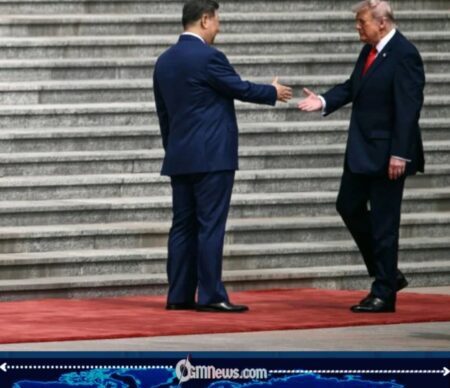
Taiwan Warning dominated the opening moments of the highly anticipated Beijing Summit between President Donald J. Trump and Chinese President Xi Jinping, immediately injecting tension into what had been promoted as a historic opportunity to stabilize relations between the world’s two largest economies. While both leaders publicly acknowledged progress in trade negotiations during the opening session in Beijing, Xi’s reported caution that the Taiwan issue could send relations “into conflict” transformed the atmosphere from ceremonial diplomacy into a reminder of the deep strategic distrust still shaping US-China relations. The warning arrived as global investors, military analysts, and allied governments closely monitored the summit for signs of either cooperation or escalation.
Taiwan Warning Reveals the Fragile Balance Behind Diplomatic Smiles
The Beijing Summit began with a carefully orchestrated reception inside Beijing’s Great Hall of the People, where Chinese officials welcomed President Donald J. Trump with elaborate ceremony designed to emphasize the significance of the meeting. Trump described the gathering as potentially the “biggest summit ever,” signaling hopes that renewed trade discussions could ease years of economic tension between Washington and Beijing. Chinese state media later reported that Xi Jinping acknowledged positive movement in trade talks while stressing that Taiwan remained the most sensitive issue between the two governments.
The Taiwan Warning immediately became the defining headline of the summit because of the increasingly fragile military and political situation surrounding the self-governed island. Beijing continues to view Taiwan as part of China and has repeatedly warned against any foreign actions it interprets as support for Taiwanese independence. The United States, meanwhile, maintains unofficial relations with Taiwan and continues military cooperation under longstanding strategic policies. Analysts say Xi’s comments reflected Beijing’s concern that trade improvements alone cannot resolve deeper security disputes that have intensified across the Indo-Pacific region in recent years.
Beijing Summit Highlights Broader Struggle for Global Influence
Beyond Taiwan, the Beijing Summit also reflects a wider competition between Washington and Beijing over economic power, technological influence, and regional security leadership. Recent years have seen disputes involving semiconductor restrictions, military activity in the South China Sea, sanctions, cyber-security accusations, and global supply chain tensions. Although both governments continue engaging in trade negotiations, experts increasingly argue that the rivalry now extends far beyond tariffs and market access.
The summit arrives during a period of heightened geopolitical sensitivity across Asia. China has increased military exercises near Taiwan, while the United States and its allies have expanded regional defense cooperation in response to growing concerns about stability in the Pacific. Diplomats familiar with previous US-China negotiations note that Taiwan consistently emerges as the most emotionally charged and politically immovable issue in bilateral relations. Even during periods of economic cooperation, both governments have historically refused to compromise publicly on matters tied to sovereignty and strategic credibility.
The Taiwan Warning also carried symbolic significance because it was delivered at the very start of the Beijing Summit rather than after negotiations concluded. Political observers interpreted the timing as an effort by Beijing to establish clear boundaries before discussions on trade and broader cooperation advanced further. Meanwhile, supporters of stronger US-China engagement argue that continued dialogue remains essential precisely because tensions have reached such a dangerous level.
As global attention remains fixed on Beijing, the outcome of the summit may shape not only trade relations but also the broader security environment across Asia and beyond. The Taiwan Warning has already ensured that the meeting will be remembered as more than a diplomatic showcase. It now stands as another reminder that behind every handshake between Washington and Beijing lies an unresolved contest over influence, sovereignty, and the future balance of global power.
[…] […]