
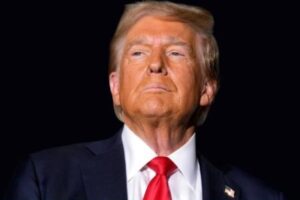


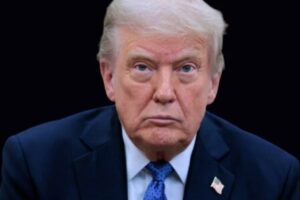



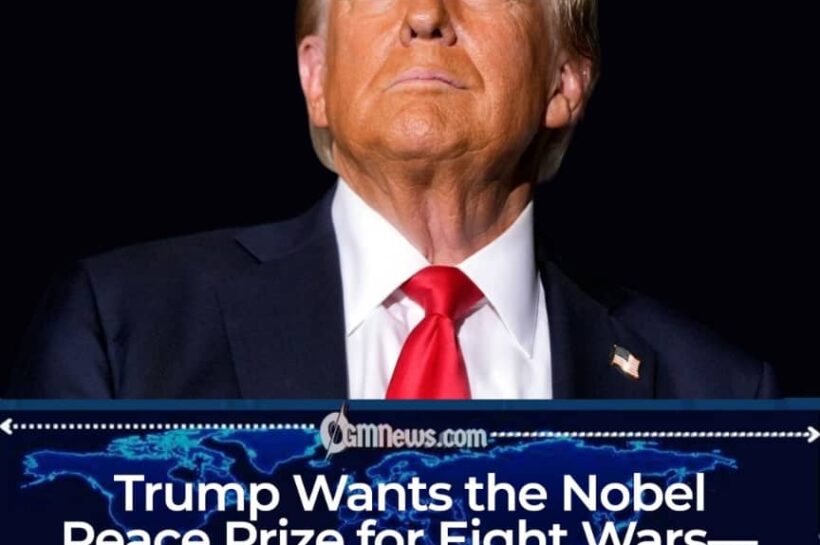














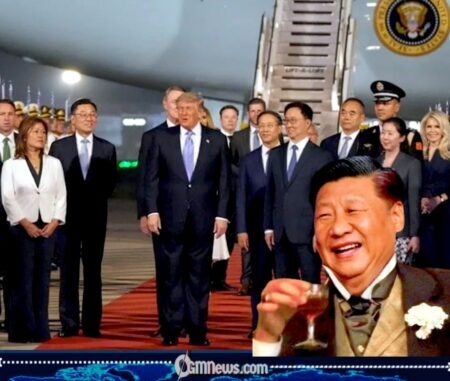
President Donald J. Trump’s landing in Beijing has sparked an international wave of speculation after images and reports suggested an unusually restrained airport reception, immediately igniting conversations about diplomatic protocol and signaling between Washington and Beijing. The absence of a visible personal welcome from Chinese President Xi Jinping has been interpreted in sharply different ways across global media and social platforms, with some framing it as routine procedure and others reading it as a symbolic message in an already complex bilateral relationship.
The incident, though grounded in standard diplomatic structure, has rapidly escalated into a narrative battleground where perception competes with procedure, and online discourse often outweighs official clarification.
Formal Diplomatic Protocol Governing State Arrivals
Reports indicate that the reception of high-level foreign leaders in Beijing typically follows established diplomatic protocol, where senior protocol officials rather than heads of state handle airport welcomes. This structure is designed to maintain consistency, security, and logistical efficiency during state visits.
In the case of President Trump’s arrival, observers noted that the reception appeared aligned with this established system. However, the visual absence of a top-tier political greeting created a perception gap that quickly fueled public debate, especially among audiences unfamiliar with the strict hierarchies of international ceremonial practice.
Public Perception, Media Interpretation, and Digital Amplification
In the digital sphere, the optics of presidential arrivals are often interpreted beyond their formal meaning, and this case was no exception. Social media users and commentators rapidly reframed the moment through competing narratives, some suggesting diplomatic tension while others emphasized procedural normalcy.
Political analysts argue that such reactions are increasingly common in the age of real-time global communication, where symbolism is often prioritized over structure. Historically, state visits between major powers like the United States and China have alternated between highly choreographed ceremonies and low-profile receptions depending on security and scheduling considerations.
Experts further note that misinterpretations often arise when viewers project political meaning onto standardized diplomatic procedures, especially in high-stakes geopolitical contexts involving Washington and Beijing.
While the current debate continues to unfold online, officials from both sides are expected to reinforce the formal nature of the visit and emphasize that diplomatic protocol remains the guiding framework for such engagements. Future updates from OGM News will monitor whether the political rhetoric surrounding the visit settles into clarification or continues to escalate in the information space.
[…] […]