























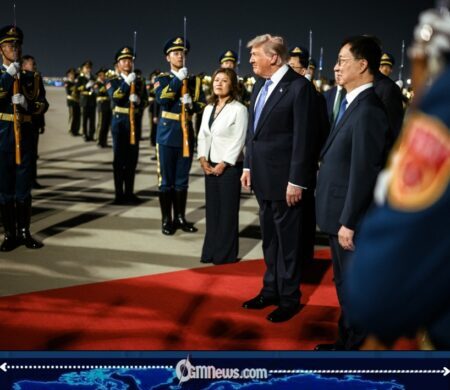
President Donald Trump arrived in Beijing for a highly anticipated Beijing Summit with Chinese President Xi Jinping, entering one of the most politically delicate moments of his presidency as global markets remain nervous over the Iran conflict, inflation fears and worsening uncertainty around international trade. The ceremonial welcome in China projected unity and stability, but behind the diplomatic smiles sits a fierce contest over rare earths, artificial intelligence, Taiwan and economic leverage between the world’s two largest powers.
Trump Arrives With Top CEOs as China Meeting Draws Global Attention
The Beijing Summit immediately attracted global attention after Trump described the United States and China as “the two superpowers” before departing Washington. Chinese officials welcomed the American president with a formal airport ceremony that included senior government representatives, military pageantry and hundreds of young people waving the flags of both nations. Trump traveled with an unusually high-profile delegation that included technology executives and business leaders, signaling that economic negotiations may carry equal importance to diplomacy.
Trump repeatedly downplayed concerns that the Iran conflict or economic pressures were motivating the trip, insisting his administration had the situation “under control.” Yet analysts note that the summit arrives as energy prices remain unstable and international shipping routes face uncertainty linked to tensions around the Strait of Hormuz. Trump’s comments that he does not think about Americans’ financial situation while prioritizing stopping Iran from obtaining nuclear weapons quickly sparked reactions online and intensified criticism from political opponents.
The Beijing Summit also generated controversy because of Trump’s unusually warm rhetoric toward Xi Jinping. His social media remark promising Xi a “big, fat hug” became a viral talking point, especially among critics who argue the administration’s tough public posture toward Beijing appears increasingly mixed with efforts to secure economic stability. At the same time, the presence of technology executives and Trump family members on Air Force One fueled further debate over the intersection between diplomacy, business influence and political power.
Rare Earths Become the Real VIPs in Trump-Xi Meeting
While trade tariffs remain a major issue, many experts now believe rare earth minerals have become the true center of gravity in U.S.-China relations. China currently dominates global refining capacity for rare earth elements used in defense systems, artificial intelligence infrastructure, semiconductors, electric vehicles and aerospace manufacturing. Reports ahead of the Beijing Summit suggested both countries may discuss extending a fragile truce tied to export restrictions that have already disrupted global supply chains.
The rare earth dispute highlights a growing strategic reality facing Washington. Despite years of efforts to reduce dependence on Chinese supply chains, Beijing still holds enormous leverage in critical industrial sectors. Recent export restrictions reportedly caused shortages and price spikes across several markets, affecting manufacturers in the United States, Europe and Asia. Analysts say this explains why the summit carries importance far beyond diplomacy, as governments and corporations fear another wave of economic instability if negotiations collapse.
Beyond economics, the Beijing Summit is expected to cover Taiwan, artificial intelligence regulations and China’s relationship with Iran. Experts close to previous U.S. administrations described the meeting as an attempt to maintain a “detente,” meaning reduced confrontation rather than genuine partnership. Both governments appear eager to prevent open escalation while preserving their own strategic advantages.
The broader geopolitical context makes the summit even more significant. Trump entered Beijing facing domestic pressure over inflation and the continuing effects of the Iran conflict, while Xi Jinping seeks to protect China’s economic growth amid international scrutiny and trade restrictions. For now, the greatest achievement may simply be that the meeting is happening at all, with both leaders trying to avoid another direct collision between two powers whose rivalry increasingly shapes the global economy.
OGM News will continue monitoring the Beijing Summit as negotiations unfold, particularly around rare earth exports, trade concessions and the possibility of new agreements that could either calm global tensions or deepen the growing strategic rivalry between Washington and Beijing.

[…] […]