



























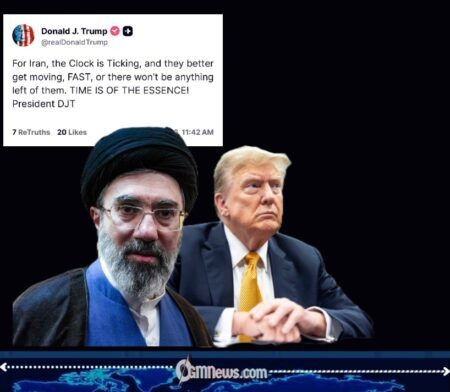
President Donald J. Trump intensified pressure on Iran on Sunday with a blunt warning that “the Clock is Ticking,” declaring there would be “nothing left” of Iran if its leaders fail to move quickly toward a diplomatic resolution. The remarks arrived at a delicate moment for the Middle East, where a shaky ceasefire involving Iran and its regional allies continues to face growing military and political strain. Trump’s message immediately triggered reactions from diplomats, analysts, and foreign officials who fear the region may be balancing between uneasy calm and another major escalation.
The latest tension comes as Iran publicly questions whether the United States can be trusted in negotiations at all. Iranian Foreign Minister Abbas Araghchi accused Washington of delivering inconsistent signals, claiming that conflicting statements from American leadership have deepened mistrust. His remarks highlighted the fragile nature of the ceasefire, which both sides appear eager to preserve publicly while simultaneously preparing for possible confrontation behind the scenes.
Clock Ticking: Trump Issues Fresh Warning to Iran
Trump’s warning was posted on Truth Social and later amplified by official White House social media accounts, signaling that the Trump administration intended the message to carry international weight. The president Trump framed the moment as urgent, insisting Iran must act quickly or face devastating consequences. The aggressive tone reflected Trump’s long-standing preference for maximum-pressure diplomacy, where public threats are often used alongside negotiations.
Iranian officials responded cautiously but critically. Araghchi, speaking during a summit in New Delhi, said Tehran is attempting to maintain the shaky ceasefire “to give diplomacy a chance,” despite deep distrust of Washington. He argued that mixed messaging from the United States has become one of the main obstacles to serious diplomatic progress. According to Iranian officials, uncertainty over America’s true intentions has complicated every stage of the current negotiations.
Iran Questions U.S. Trust While Ceasefire Holds by a Thread
The shaky ceasefire has also been tested by developments beyond Iran itself. Israel recently agreed to extend its ceasefire arrangement with Lebanon for another 45 days following talks in Washington, yet military operations have continued. Israeli forces reportedly launched more than 100 strikes in southern Lebanon since Friday, while casualties among Israeli troops have also been confirmed. The contradiction between diplomatic agreements and ongoing military action has fueled skepticism about whether regional powers are genuinely committed to de-escalation.
Another critical issue remains the Strait of Hormuz, one of the world’s most strategically important shipping routes. Trump claimed the United States now effectively controls the waterway and asserted that Iranian military capabilities had been severely weakened. Iranian officials countered by announcing plans to introduce a payment system for some ships seeking passage through the strait, a proposal that could further increase global tensions over oil prices and maritime security. Analysts warn that even limited disruption in the area could trigger economic consequences far beyond the Middle East.
The broader crisis reveals a region trapped between diplomacy and brinkmanship, where public statements often sound more like ultimatums than peace efforts. While leaders continue to speak about negotiations, military strikes, threats, and political distrust remain deeply embedded in the situation. OGM News understands that international mediators are still quietly pushing for stability, but the coming days may determine whether the shaky ceasefire survives or becomes another temporary pause before a wider confrontation returns.


[…] […]