



















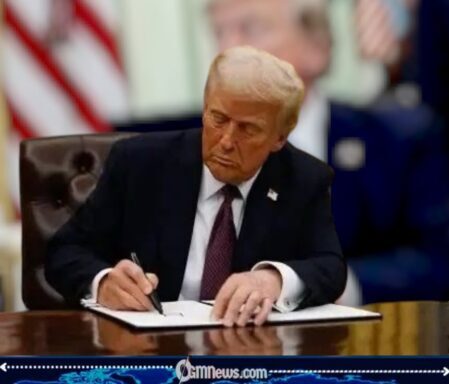
Cyber operations are taking a more aggressive turn under President Donald J. Trump after he signed a national security presidential memorandum authorizing a new framework for using cyber capabilities against transnational criminal organizations operating abroad. The White House says the measure is intended to strike ransomware gangs, financial-fraud networks and other foreign criminal groups targeting Americans. But beneath the tough language sits an unusually significant development: vetted private companies could participate in cyber operations under the direction and control of the U.S. government. In Washington, apparently, even the crime-fighting toolbox now comes with a corporate partnership agreement. (Reuters)
Trump’s Cyber Offensive Raises Questions About Who Controls the Digital Battlefield
The memorandum directs the Department of Homeland Security, through its Homeland Security Task Force’s National Coordination Center, to establish a programme for specific cyber operations designed to disrupt foreign transnational criminal organizations. According to the White House, participating companies would be vetted and operate under federal supervision, while working alongside federal, state, local, tribal and territorial authorities to collect threat information and propose operations. (Reuters)
The contemplated activities go considerably beyond simply monitoring suspicious online activity. The memorandum describes cyber surveillance and “cyber effects” operations that could include manipulating, disrupting, denying or degrading information systems, networks and infrastructure controlled through those systems. Participating companies would also be required to maintain a bond or escrow of at least $1 million, adding a rather expensive security deposit to America’s new digital crime-fighting arrangement. (Reuters)
Private Firms Get a Role in Trump’s Offensive Cybercrime Strategy
The decision builds on an earlier Trump administration effort to combat cybercrime. In March, President Donald J. Trump signed an executive order directing officials to develop an action plan for identifying and disrupting transnational criminal organizations involved in cyber-enabled fraud, ransomware, extortion and related schemes. That order also envisioned cooperation with commercial cybersecurity firms and other non-government entities. (The White House)
The latest memorandum therefore represents an expansion of an existing policy direction rather than an entirely new campaign. Its unusual feature is the clearer framework for private-sector participation in government-directed cyber operations. Supporters see that as a way to combine government authority with the technical expertise of cybersecurity companies; critics and security specialists have long warned that offensive cyber activity can create escalation, coordination and unintended-consequence risks. The administration’s challenge will be proving that the digital weapons being authorized against criminal networks remain tightly controlled and legally accountable. (Reuters)
The Trump administration is presenting the initiative as a stronger response to criminal networks that increasingly operate across borders and exploit digital infrastructure to reach American victims. The policy could give U.S. authorities additional tools against organizations that are difficult to reach through conventional law enforcement. At the same time, the involvement of private companies in offensive operations means questions about oversight, attribution and responsibility are likely to follow the programme wherever it goes. OGM News will continue watching the implementation closely, because the next chapter may reveal whether this cyber strategy becomes an effective weapon against international crime—or another Washington experiment whose biggest battles take place behind computer screens.

mjpKyJqtopJmUkjsHEeNp