




























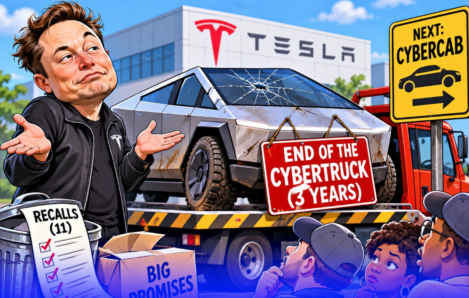
What was once celebrated as the future of pickup trucks is now preparing for an early retirement, and the irony is almost as sharp as its stainless-steel edges. Tesla CEO Elon Musk has announced plans to wind down production of the Tesla Cybertruck at the company’s Texas Gigafactory around mid-2027, bringing an unexpectedly short production run to a vehicle he once enthusiastically described as Tesla’s “best product ever.” Launched with extraordinary promises, futuristic marketing, and ambitions to revolutionize America’s pickup truck market, the Cybertruck has struggled to turn its celebrity status into sustained commercial success. Industry estimates put cumulative sales at roughly 70,000 to 73,000 vehicles since deliveries began in late 2023. Apparently, designing a truck that looks like it escaped from a science-fiction movie is one thing; convincing hundreds of thousands of Americans to park one in their driveways is quite another. Fortune+2
From the World’s Most Anticipated Truck to an Expensive Reality Check
When Musk unveiled the Cybertruck in November 2019, the vehicle arrived with the kind of publicity most automakers could only dream of. Its angular stainless-steel body, futuristic appearance, and ambitious performance claims promised to challenge conventional pickup trucks. Musk projected that Tesla could eventually produce approximately 250,000 Cybertrucks annually, while the original presentation advertised an entry-level price below $40,000. But reality began interrupting the excitement almost immediately. During the unveiling, a demonstration intended to prove the strength of the vehicle’s windows ended with two cracked panes of glass. It was perhaps the most unintentionally honest product demonstration in automotive history: the future had arrived, and somebody had already broken the windows. Investing.com+1
The commercial disappointment became clearer after deliveries began in November 2023. Industry estimates indicate Tesla sold approximately 38,965 Cybertrucks in 2024, followed by just 20,237 in 2025, a decline of nearly 48 percent. Sales continued weakening in 2026, with an estimated 11,586 units sold during the first nine months. Meanwhile, the vehicle’s actual selling prices climbed far beyond the original affordable-truck promise, with currently available premium versions approaching or exceeding $90,000. That is quite a transformation: a vehicle introduced as a revolutionary pickup for ordinary drivers increasingly became a luxury-priced conversation starter. Musk promised to challenge America’s most popular trucks, but the Cybertruck ended up challenging something far more fundamental: how much customers were willing to pay for an unconventional design. Car and Driver+1
Recalls, Controversies, and the Trouble With Selling the Future
Beyond disappointing sales, the Cybertruck encountered repeated quality-control problems and recalls. Its unconventional construction created engineering challenges, while various safety and manufacturing issues attracted regulatory attention. By November 2026, the model had experienced 11 recalls, according to a review of its troubled history. Although recalls are not unusual across the automotive industry, the Cybertruck’s problems carried particular reputational consequences because Musk had promoted it as an exceptionally durable and technologically advanced machine. The vehicle that was supposed to make traditional pickup trucks look outdated instead became a frequent subject of online jokes, critical reviews, and questions about whether Tesla’s marketing promises had raced too far ahead of practical engineering. Investing.com+1
The Cybertruck also became entangled in America’s increasingly polarized political environment. Musk’s outspoken political activities, including his alignment with President Donald Trump, helped transform the vehicle into something beyond an automobile: a rolling symbol of its creator’s public persona. Some owners embraced that identity, while critics associated the truck with Musk’s politics, contributing to protests, boycotts, and public hostility toward certain Tesla vehicles. Still, the Cybertruck developed a loyal following among drivers who admired its distinctive styling and technology. Its commercial struggles therefore cannot be explained by politics alone. High prices, limited mainstream appeal, competition, recalls, and shifting consumer expectations all played a part. In the end, even the loudest cultural controversy cannot substitute for customers walking into showrooms and buying trucks. AP News+2
Tesla Moves On to Cybercab as Musk’s Biggest Pickup Dream Fades
Musk has explained that winding down Cybertruck production will free manufacturing capacity at Gigafactory Texas for increased production of Tesla’s Tesla Cybercab, a purpose-built autonomous vehicle central to the company’s robotaxi ambitions. The decision reflects Tesla’s broader effort to position artificial intelligence, autonomous transportation, and robotics as major drivers of its future growth. However, Musk’s announcement leaves an important question unresolved: whether Cybertruck production will disappear entirely or move to another facility. No alternative manufacturing location has been confirmed, making a complete phaseout appear increasingly likely. The Cybertruck may therefore become a cautionary chapter in Tesla’s history, while the company prepares to place another enormous bet on technology that promises to transform transportation. Investing.com+2
There is also the uncomfortable question of what happens to existing Cybertruck owners. Those who paid premium prices for a vehicle marketed as the future of automotive engineering now face the prospect of owning a discontinued model after a relatively brief production run. Tesla has not provided a detailed public timetable explaining the long-term implications for replacement parts, servicing, or remaining inventory, although ending production does not automatically mean abandoning customer support. Musk has insisted that the existing Cybertruck fleet will remain on the road for years. Nevertheless, the contrast between the original promises and today’s announcement is difficult to ignore. A truck once promoted as the beginning of a new automotive era may soon be remembered as an expensive experiment that lasted barely long enough to finish its own introduction. Fortune+2
Ultimately, the Cybertruck’s approaching exit represents more than the disappointing performance of one electric pickup. It illustrates the enormous gap that can emerge between visionary marketing, ambitious executive predictions, and the realities of consumer demand. Elon Musk promised a revolutionary vehicle capable of reshaping America’s pickup truck market, but after roughly three years, an estimated 73,000 sales, repeated recalls, and persistent pricing challenges, Tesla is preparing to redirect its resources toward autonomous transportation. Whether the Cybercab becomes the breakthrough Musk envisions or another expensive lesson in technological optimism remains to be seen. For now, the Cybertruck appears to be approaching its final stop, leaving one rather awkward question behind: if this was Tesla’s “best product ever,” what exactly happened to the customers? Stay with OGM News for further updates as Tesla prepares to close this controversial chapter and pursue its next automotive revolution.



Great selection of live dealer games. The streaming quality is crystal clear and the dealers...