






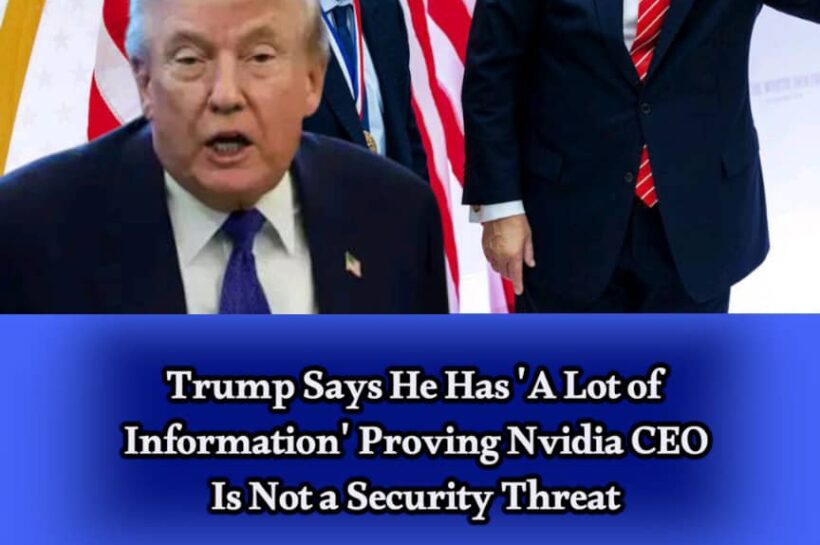








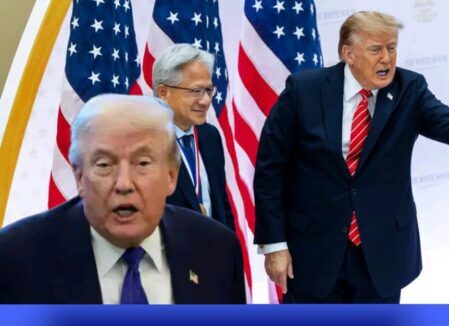
President Donald Trump has once again defended Nvidia CEO Jensen Huang against national security concerns, insisting that the technology executive poses no threat to the United States. However, when reporters asked what evidence supported his confidence, Trump offered little explanation beyond claiming he possessed “a lot of information.”
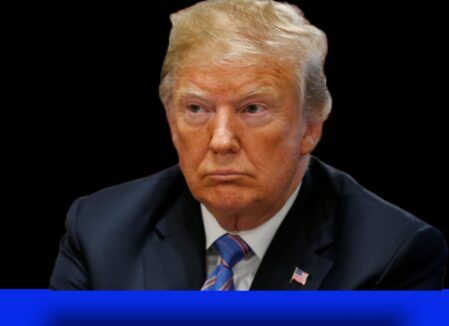
During a Thanksgiving exchange with journalists at Mar-a-Lago on November 27, Trump was asked how he could be certain Huang was not a security threat when the Justice Department had not conducted what the reporter described as a proper investigation.
“Based on information and belief. I think he’s absolutely fine,” Trump responded.
When the journalist followed up by asking what information he was referring to, Trump replied: “The information I have, which is a lot of information.”
The exchange has intensified questions about the government’s assessment of Huang, particularly because Reuters reported that the Justice Department did not formally investigate the Nvidia CEO or open a counterintelligence investigation into him before Trump pushed for his reinstatement.
Trump Offers Confidence Instead of Specific Evidence
Trump’s response was striking because the question concerned a matter of national security involving one of America’s most strategically important technology companies.
Rather than identifying specific intelligence findings, investigative conclusions or security assessments, the president relied on his personal assurance that Huang was “absolutely fine.”
Trump did not publicly explain what information he had received, who provided it or whether it came from intelligence agencies, law enforcement officials or other government sources.
His confidence is particularly important because Nvidia manufactures advanced artificial intelligence processors that have become central to the global technology industry and the competition between the United States and China.
The question is therefore not simply whether Huang is a successful businessman. It is whether the government has adequately assessed the potential security implications surrounding his reported personal and business associations.
Reuters Reports No Formal Investigation Into Huang
A November 25 Reuters investigation reported that the Justice Department did not formally investigate Huang before Trump intervened to support his return to Nvidia.
According to people familiar with the matter, Attorney General Todd Blanche concluded that there was no evidence Huang had broken the law or knowingly helped transfer sensitive American technology to China.
However, that assessment was based partly on ongoing criminal investigations involving two Nvidia customers, Super Micro Computer and Megaspeed International.
Reuters reported that Nvidia was not a target of those investigations but cooperated by providing documents, interviews and other information.
Crucially, the absence of evidence establishing wrongdoing is not the same as the completion of a dedicated counterintelligence investigation into every potential national security concern.
Reuters also reported that US intelligence agencies had collected information about Alice Huang, a former Megaspeed executive reportedly associated with Jensen Huang, whose alleged connections to Chinese intelligence had attracted official attention.
The extent of those connections and whether any sensitive information was obtained or transferred remain unresolved.
JD Vance’s Explanation Adds Another Layer of Confusion
The controversy has also produced conflicting descriptions from senior members of the Trump administration.
Vice President JD Vance said that officials had assured him Huang was not under investigation and that the allegations against him were based on anonymous reporting rather than actual evidence.
Vance’s comments appeared to differ from Trump’s earlier description of the Justice Department’s work as a “pretty good investigation” that had effectively exonerated Huang.
The distinction matters.
Being told that someone is not under investigation is not the same as saying that the person has undergone a comprehensive investigation and has been formally cleared of every security concern.
Reuters reported that the Justice Department had reached an assessment based on related investigations, but no formal criminal or counterintelligence probe into Huang himself had been opened.
Why the Alice Huang Allegations Matter
The national security concerns surrounding Jensen Huang have been linked partly to reports about his relationship with Alice Huang, a former executive at Megaspeed International.
US intelligence officials reportedly examined her contacts with individuals associated with China’s Ministry of State Security.
However, the available reporting does not establish that Jensen Huang knowingly participated in espionage, supplied classified information to China or committed an export-control offence.
Reuters also reported that intelligence officials had not reached a definitive conclusion about whether Alice Huang was working for Chinese intelligence.
These distinctions are important. Allegations and intelligence concerns should not automatically be treated as proof of criminal conduct.
Nevertheless, questions about possible access to sensitive commercial information and advanced semiconductor technology are legitimate matters for national security officials to examine.
Trump’s Intervention in Nvidia’s Leadership
Huang resigned from Nvidia on November 12 following reports about his personal relationships and the controversy surrounding his associations.
Eleven days later, Nvidia announced that its board had unanimously reinstated him as president, CEO and board director.
Trump has openly taken credit for supporting the decision, arguing that Huang is essential to Nvidia and American technological competitiveness.
The president has also acknowledged that he was concerned about the company’s stock performance and believed Huang’s return would benefit the American economy.
Nvidia said its board had received input from senior US government officials and was confident that Huang’s return did not pose a national security risk.
However, the circumstances surrounding the government’s assurances have attracted criticism from lawmakers and national security observers who want clearer answers about what was examined and what remains unresolved.
The Question Trump Has Yet to Answer
Trump’s latest response leaves an important question hanging over the controversy: if he has so much information proving Huang is safe, why not explain the basis of that assessment?
National security information cannot always be disclosed publicly. Some intelligence findings may be classified, and the government has legitimate reasons to protect sensitive sources and methods.
But that does not eliminate the need for a credible assessment, particularly when the president has personally intervened in the leadership of a major technology company.
The public does not need access to classified intelligence to expect a clear explanation of whether appropriate security procedures were followed.
Confidence Is Not the Same as an Investigation
Trump may genuinely believe Jensen Huang poses no threat to American national security. The Justice Department’s reported assessment also found no evidence that Huang had committed a crime or knowingly facilitated the transfer of sensitive technology to China.
But the distinction between an absence of established wrongdoing and a comprehensive security investigation remains central to this controversy.
For now, Trump is offering confidence, the administration is pointing to assurances from officials, and important questions about the scope of the security assessment remain unanswered.
The issue is no longer simply whether Huang deserves another opportunity to lead Nvidia. It is whether the government applied a sufficiently rigorous process before declaring that one of America’s most influential technology executives poses no national security risk.
Follow OGM News for more updates on Donald Trump, Jensen Huang, Nvidia, artificial intelligence and national security developments.

What a fantastic spot for casino lovers! I have been playing here for a few...