




























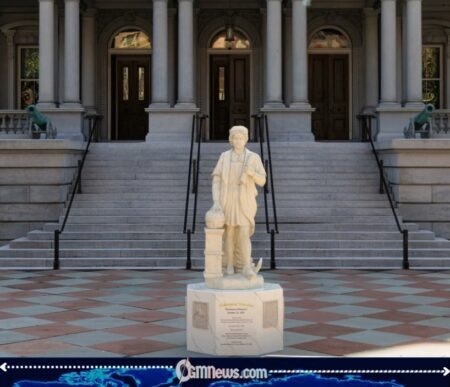
In a move that has reignited long-standing debates over American history and national identity, Donald Trump has overseen the installation of a statue of Christopher Columbus on the grounds of the White House. The monument, standing 13 feet tall and weighing approximately one ton, now sits prominently outside the Eisenhower Executive Office Building along Pennsylvania Avenue.
The statue is not entirely new. It is a reconstructed replica of a monument that was torn down during protests in 2020 in Baltimore and subsequently thrown into the city’s Inner Harbor. The reinstallation reflects an effort by the administration to restore what it views as a foundational historical symbol, while also sending a broader message about heritage and national pride.
According to official statements, the statue was built in 2022 using fragments recovered from the harbor. Its pedestal bears an inscription marking its destruction, reconstruction, and eventual rededication in October 2025, anchoring the monument in both past conflict and present political symbolism.
Historical Context and Political Messaging
President Trump has framed the installation as part of a broader commitment to preserving American history. In correspondence with Basil Russo, head of the Conference of Presidents of Major Italian American Organizations, the president described Columbus as “the original American hero” and praised his vision and courage.
The White House reinforced this stance in public communications, emphasizing that Columbus would be honored “for generations to come.” Supporters of the decision argue that the monument recognizes the explorer’s role in shaping Western history and reflects the cultural pride of many Italian Americans who view him as a symbol of their heritage.
Critics, however, interpret the move as a political statement aimed at countering recent efforts to reassess historical narratives. For them, the statue represents a selective reading of history that overlooks the broader consequences of European exploration in the Americas.
Columbus: A Divisive Historical Figure
The legacy of Christopher Columbus has been a subject of intense debate for decades. Traditionally credited with “discovering” the Americas, Columbus never actually set foot on the continental United States, instead landing in regions now known as the Bahamas and the Caribbean during voyages between 1492 and 1504.
Modern historical scholarship has increasingly highlighted the darker aspects of his expeditions. These include his involvement in the enslavement of Indigenous peoples and the violent systems imposed during early European colonization. As a result, Columbus has come to symbolize both exploration and exploitation, depending on the perspective.
This duality has led to widespread reconsideration of how he is commemorated. Across the United States, monuments have been removed or relocated, and public opinion remains sharply divided on whether Columbus should be celebrated or critically reexamined.
From Protest to Reconstruction
The origins of the newly installed statue trace back to the wave of protests that followed the George Floyd protests. During that period, demonstrators targeted monuments associated with colonialism and racial injustice, including the original Columbus statue in Baltimore.
The statue was dismantled and thrown into the harbor on July 4, 2020, an act that drew both condemnation and support nationwide. For some, it represented a rejection of historical figures linked to oppression; for others, it was viewed as an erasure of history.
Efforts to recover and rebuild the monument began shortly afterward. The reconstructed statue, completed in 2022, incorporates fragments of the original, symbolically linking its destruction to its present reinstallation. The decision to place it at the White House elevates its significance from a local monument to a national statement.
Shifting National Narratives
The controversy surrounding Columbus is part of a broader reassessment of American history. In recent years, several states and municipalities have replaced Columbus Day with Indigenous Peoples’ Day, reflecting a growing recognition of Native American experiences and perspectives.
In 2021, then-president Joe Biden acknowledged the harms associated with Columbus’s expeditions, citing violence, displacement, and the spread of disease among Indigenous populations. His remarks underscored a shift toward a more critical understanding of historical events.
Despite these changes, Columbus remains a prominent figure in American culture. The nation’s capital, the District of Columbia, bears his name, and many communities continue to honor him as part of their cultural heritage. This coexistence of reverence and criticism illustrates the complexity of national memory.
Public Reaction and Ongoing Debate
The installation of the statue has elicited mixed reactions across the political and cultural spectrum. Supporters argue that it restores a sense of historical continuity and counters what they perceive as efforts to erase traditional narratives.
Opponents, however, see the move as dismissive of Indigenous perspectives and the historical suffering associated with European colonization. They argue that public monuments should reflect a more inclusive and accurate account of history, rather than celebrating figures with contested legacies.
As debates continue, the statue is likely to remain a focal point for discussions about how the United States remembers its past. Its presence at the White House ensures that these conversations will persist at the highest levels of national discourse.
Ae888covenuscasino, okay, I'm curious. Gonna check out this site and try to find some amazing...