




















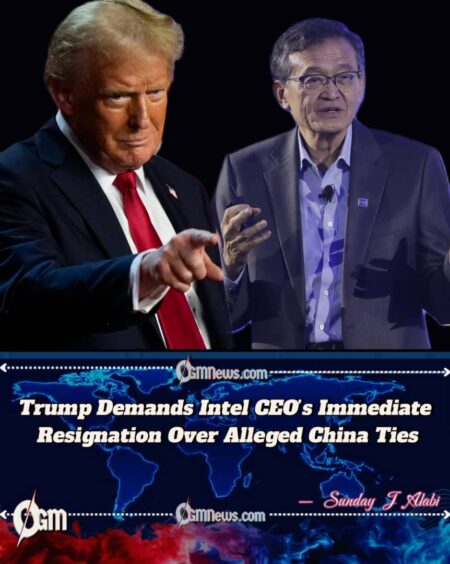
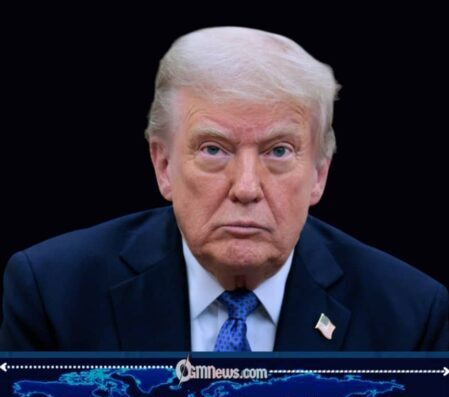
President Donald Trump has called for the immediate resignation of Intel’s chief executive, Lip-Bu Tan, alleging that the veteran semiconductor executive has problematic financial ties to China. In a blunt social media post on Thursday, Trump declared that Tan was “highly conflicted” and unfit to lead a company that plays a critical role in America’s high-tech and defense supply chain.
The demand, unusual for a sitting president to make towards the head of a private corporation, comes as Intel navigates a turbulent period marked by falling market share, large-scale layoffs, and intensified government scrutiny over its global business relationships. Tan, appointed in March to spearhead a turnaround at the iconic chipmaker, has faced mounting criticism from Washington over past investments in companies linked to the Chinese military.
President Trump Rebuke Unprecedented in Tone and Target
Trump’s remarks mark one of his most aggressive interventions into the leadership of a major U.S. corporation. While he has previously used public pressure to influence corporate decisions, directly calling for a CEO’s resignation represents a sharp escalation in his approach to business oversight.
“The CEO of INTEL is highly CONFLICTED and must resign, immediately. There is no other solution to this problem,” Trump posted, citing reports of Tan’s financial involvement in China-based firms flagged by U.S. security agencies. The president’s comments echoed concerns raised earlier this week by Republican Senator Tom Cotton, who warned that Tan’s associations could undermine Intel’s ability to safeguard taxpayer-funded semiconductor projects.
Intel Defends Leadership Amid Washington Backlash
In a statement responding to the president’s comments, Intel reiterated its commitment to U.S. national and economic security, stating: “Intel, the Board of Directors, and Lip-Bu Tan are deeply committed to advancing U.S. national and economic security interests. We look forward to our continued engagement with the administration.”
The company, a key beneficiary of billions of dollars in federal subsidies aimed at reviving domestic chip manufacturing, has sought to align itself with Trump’s “America First” industrial policy. However, Tan recently told investors that Intel would scale back some manufacturing investments to match customer demand—a move that may have compounded tensions with the White House.
Controversy Over Ties to China and Past Corporate Dealings
Tan, a naturalized U.S. citizen born in Malaysia and raised in Singapore, is a respected figure in the semiconductor sector with decades of experience. However, a 2024 congressional report and a Reuters investigation earlier this year alleged that he invested in hundreds of Chinese companies, including firms linked to the Chinese military, between 2012 and late 2024.
While Tan has not been accused of any criminal wrongdoing, critics point to his tenure as CEO of Cadence Design Systems, which in July pleaded guilty and agreed to pay $140 million after a Chinese subsidiary violated U.S. export controls by doing business with China’s National University of Defense Technology. Tan himself was not indicted in that case.
Industry Analysts See Strategic Pressure From White House
Technology analyst Patrick Moorhead suggested that Trump’s attack may be part of a broader negotiation over Intel’s U.S. manufacturing commitments and reported ties to Taiwan’s TSMC, a partnership allegedly backed by the White House. “Trump probably saw, ‘Ok, I’ve got an opportunity to turn up the heat with Intel on this,’” Moorhead said.
Other industry figures have noted that tech executives targeted by Trump in the past have often responded with high-profile pledges to expand U.S. operations. Moorhead added that Intel may have underestimated the political importance of demonstrating loyalty to the administration’s domestic manufacturing agenda.
Political Allies and Opponents Weigh In
Republican Senator Bernie Moreno, a close Trump ally, criticized Intel for delays in its U.S. chip plant projects, saying the firm risked undermining the country’s ability to compete with China in critical technology sectors. Meanwhile, the White House defended Trump’s comments, telling the BBC: “President Trump remains fully committed to safeguarding our country’s national and economic security. This includes ensuring that iconic American companies in cutting-edge sectors are led by men and women who Americans can trust.”
Democrats, however, expressed concern that such direct presidential intervention in corporate governance could unsettle markets. Intel’s shares fell over 3% by midday Thursday, highlighting investor unease over the public dispute.
A Test for America’s Semiconductor Revival Plan
Intel has been central to Washington’s push to rebuild domestic semiconductor capacity, a strategic priority as the U.S. seeks to reduce reliance on Asian supply chains for advanced chips. Industry experts warn that the leadership dispute could disrupt the company’s recovery efforts and complicate its role in America’s long-term technology strategy.
“Intel has been a hope for America to build out more chip capacity and has struggled to do so to date,” said Janet Egan, senior fellow at the Center for a New American Security. “It’s important that we get continuity of leadership to support that ramping up of capacity.”
For now, Tan remains in his role, but with the president’s call for his resignation reverberating across Wall Street and Capitol Hill, the standoff could shape both Intel’s corporate future and the broader battle for technological dominance between the United States and China.
[…] […]