
















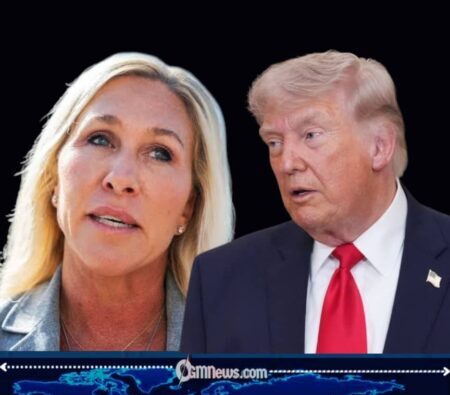
U.S. political figure Marjorie Taylor Greene has sharply criticized President Donald Trump, stating that he “has gone insane” and asserting that his actions and rhetoric are inconsistent with Christian values. Her remarks came in response to Trump’s controversial statements threatening military strikes on Iranian infrastructure, which were issued during a religious holiday.
The comments mark a notable escalation in internal political tensions, as Greene long associated with Trump’s political base—publicly distanced herself from the president’s recent approach to foreign policy and messaging.
Trigger: Trump’s Controversial Easter Message
The criticism from Marjorie Taylor Greene followed a widely reported message from President Donald Trump in which he threatened potential strikes against Iranian infrastructure, including power plants and bridges. The timing of the message, coinciding with Easter, drew particular attention.
Reports indicate that the statement included strong language and reflected a heightened tone amid escalating tensions with Iran. Analysts suggest that such messaging represents a significant departure from conventional diplomatic communication, particularly during a religious observance.
The remarks quickly drew reactions across the political spectrum, with Greene’s response standing out due to its directness and intensity.
Greene’s Criticism: ‘He Has Gone Insane’
In a detailed response, Marjorie Taylor Greene described the president’s actions as deeply concerning. She stated that Trump “has gone insane,” adding that those around him should take steps to address what she characterized as troubling leadership behavior.
Greene also criticized the broader implications of the rhetoric, arguing that it risks escalating conflict and undermining stability. Her comments reflect growing unease among some political figures regarding the direction of U.S. foreign policy during the ongoing crisis.
Observers note that such direct criticism from a figure closely aligned with Trump is relatively rare, highlighting the significance of the moment.
Religious Dimension: Questioning Trump’s Faith
A central element of Greene’s remarks was her assertion that President Donald Trump is “not a Christian.” This statement introduced a religious dimension to the political debate, emphasizing the perceived disconnect between Trump’s rhetoric and Christian teachings.
Marjorie Taylor Greene argued that Christian leaders and followers should prioritize peace, restraint, and moral consistency. She suggested that the president’s statements, particularly during a religious holiday, failed to reflect those principles.
The comments have reignited broader discussions about the role of religion in political leadership and the expectations placed on public officials by faith-based communities.
Signs of Division Within Trump’s Political Base
The exchange highlights emerging divisions within the political movement that has supported President Donald Trump. While many continue to back his policies, some voices have begun to express concern over the tone and direction of recent decisions.
Analysts point to a growing debate among conservative figures regarding military engagement abroad, particularly in relation to Iran. Some argue that escalation contradicts longstanding “America First” principles, while others support a more assertive stance.
Marjorie Taylor Greene’s remarks are seen as part of this broader conversation, reflecting differing perspectives within the same political coalition.
Political and Strategic Implications
The public nature of the criticism may carry implications for both domestic politics and international perceptions. Internally, it underscores the challenges of maintaining unity within a diverse political base during periods of crisis.
Externally, such statements may be interpreted by international observers as evidence of internal debate within the United States. This could influence how allies and adversaries assess U.S. policy consistency and decision-making.
President Donald Trump, currently serving a second term, has continued to emphasize a strong approach to Iran, even as criticism from figures like Marjorie Taylor Greene adds complexity to the political landscape.
The remarks by Marjorie Taylor Greene represent a significant moment in the evolving political discourse surrounding U.S. foreign policy and leadership. By directly challenging President Donald Trump on both strategic and moral grounds, Greene has highlighted underlying tensions that may shape future debates. As the situation develops, the intersection of politics, religion, and international conflict will remain central to public discussion.

Logging in is a breeze and the site stability is amazing even during peak hours....