


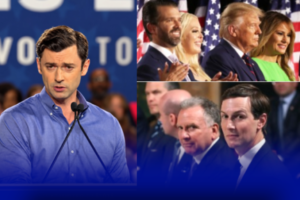



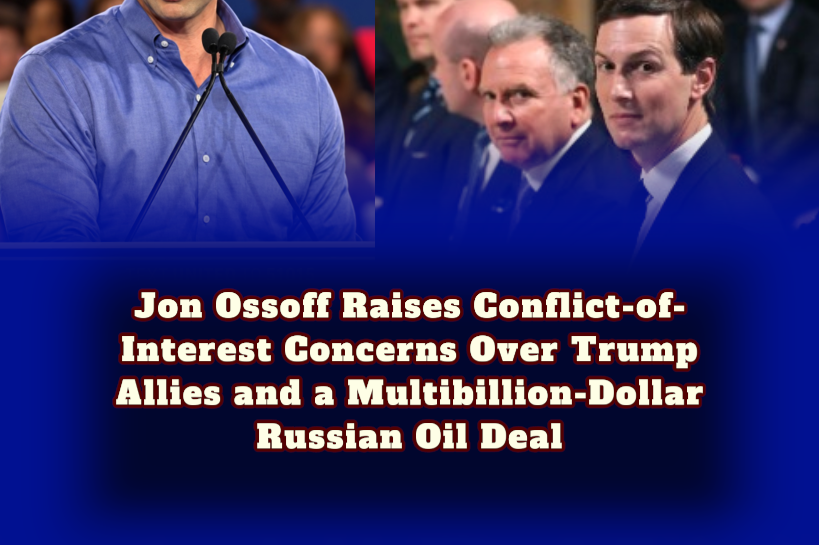




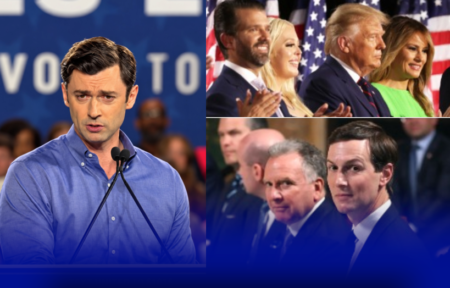
Georgia Democratic U.S. Senator Jon Ossoff has raised concerns about the possibility that President Donald Trump’s family associates and business allies could benefit financially from negotiations involving Russian oil assets while the Trump administration pursues diplomatic discussions with Moscow. The controversy centers on reports that Trump’s son-in-law, Jared Kushner, and special envoy Steve Witkoff have been involved in discussions surrounding the potential sale of international assets belonging to Russian energy giant Lukoil. The proposed transaction could involve investors with business ties to the administration’s negotiators, prompting questions about conflicts of interest and whether private financial interests could overlap with official foreign policy. The allegations do not establish that Trump or his family will personally profit from the proposed deal, but they raise a significant question for public accountability: who stands to benefit when diplomacy and billion-dollar business transactions occupy the same negotiating table?
Jon Ossoff’s Alleged Bombshell Puts Trump Family Business Connections Under the Microscope
The controversy follows reporting that negotiations over ending Russia’s war against Ukraine have expanded to include a proposed multibillion-dollar purchase of Lukoil’s international oil fields, refineries and other assets. Jon Ossoff wasted no time in referencing recent Reuters reporting published in early October, drawing attention to questions surrounding the proposed transaction. According to Reuters’ account of reporting by The New York Times, the potential investor group includes billionaire investor Todd Boehly, Middle Eastern business groups with connections to the families of Jared Kushner or Steve Witkoff, and an arm of the U.S. government. The deal would require approval from both Washington and Moscow. Although these reported connections do not establish wrongdoing, they raise legitimate questions about transparency, particularly when individuals involved in sensitive diplomatic negotiations may have professional or financial relationships with people positioned to benefit from a major business transaction.
And here is where the political irony becomes difficult to ignore. Jon Ossoff’s reference to the reporting brings a broader accountability question into focus: the U.S. government is involved in discussions concerning assets belonging to a major Russian oil company, while individuals reportedly connected to the negotiators may be among those interested in the business opportunity. Washington may frame such discussions as part of a broader strategy to secure peace and reopen economic opportunities, but Americans are entitled to ask how potential conflicts of interest are identified, disclosed and managed. Diplomacy is complicated enough without leaving citizens wondering whether the negotiating room is also becoming a networking event for well-connected investors. The central issue is not whether private investors should participate in international business; it is whether public decisions are being made exclusively in the national interest and whether adequate safeguards exist to demonstrate that they are.
Ultimately, the controversy raises a question that should concern Americans regardless of party affiliation: where does public diplomacy end and private financial interest begin? By bringing the reported oil deal into the political conversation, Jon Ossoff has highlighted an issue that deserves clear answers rather than partisan deflection. When people close to a president participate in sensitive international negotiations while maintaining substantial business relationships, transparency is essential. The existence of a potential deal does not, by itself, prove misconduct. Nevertheless, the public deserves clarity about who stands to benefit, how the transaction could affect U.S. policy toward Russia, and what safeguards are in place to prevent private financial interests from influencing government decisions. Ultimately, public confidence depends not merely on officials insisting that they are acting in the national interest, but on their willingness to demonstrate it.
Jon Ossoff Listed Russian Oil, High-Stakes Negotiations and the Kushner Connection
Jon Ossoff wasted no time in referencing recent Reuters reporting published in early October described discussions involving the possible sale of Lukoil’s international assets, including oil fields, refineries and gas stations. According to reporting cited by Reuters, Putin raised the proposal during a September 5 meeting with Kushner and U.S. envoy Steve Witkoff. The group reportedly interested in acquiring the assets includes American investor Todd Boehly and Middle Eastern business groups with connections to the negotiators’ families. The proposed transaction would require relevant approvals, and the reporting did not establish that a final sale had been completed.
Here is where the political irony becomes difficult to ignore. The Trump administration is negotiating with Moscow over a war that has reshaped European security, while a proposed commercial transaction involving Russian energy assets reportedly includes investors with ties to people participating in those negotiations. Supporters may argue that business incentives can help bring adversaries to the negotiating table. Critics, however, have reason to ask whether such arrangements could create competing incentives for the people entrusted with representing American interests. Diplomacy may involve complicated bargains, but the public should not have to solve a financial detective story to understand whose interests are being served.
Jon Ossoff Also Highlighted Millions in Foreign-Linked Investments: A Conflict-of-Interest Question
The broader financial context adds another layer to the controversy. PBS NewsHour reported in April 2026 that Trump family businesses, including ventures associated with his sons and Kushner, had expanded during Trump’s second term, generating hundreds of millions of dollars and prompting concerns about potential conflicts of interest. Separately, Democratic senators have criticized foreign investment in the Trump family’s cryptocurrency business, arguing that financial relationships with foreign power brokers deserve closer scrutiny. These reports do not prove that any particular investment improperly influenced a government decision, but they explain why Jon Ossoff and other critics are demanding greater transparency.
The administration’s defenders can argue that private investment and international diplomacy are not inherently incompatible, particularly when experienced businesspeople help negotiate complex economic arrangements. Yet the ethical question cannot simply be waved away with the promise of prosperity or peace. If investors connected to government negotiators stand to benefit from a transaction involving a foreign adversary, the public needs clear information about financial interests, decision-making authority and safeguards against preferential treatment. Otherwise, even a legitimate diplomatic initiative risks being overshadowed by suspicions that access to political power has become a business advantage. In Washington, where the revolving door between government and private enterprise is hardly new, transparency is not an optional accessory.
Jon Ossoff ‘s allegations bring renewed attention to a potentially consequential intersection of Russian energy assets, Ukraine peace negotiations and business interests linked to President Trump’s inner circle. The reported Lukoil transaction remains subject to approvals, and the existence of financial connections does not establish that improper conduct has occurred. Nevertheless, the questions surrounding disclosure, accountability and potential conflicts of interest deserve serious examination. OGM News will continue following developments in the negotiations, the financial relationships involved and any responses from the administration or the parties concerned. The central question remains: can Americans be confident that decisions affecting national security are being made in the public interest?
Hi,how are you