



























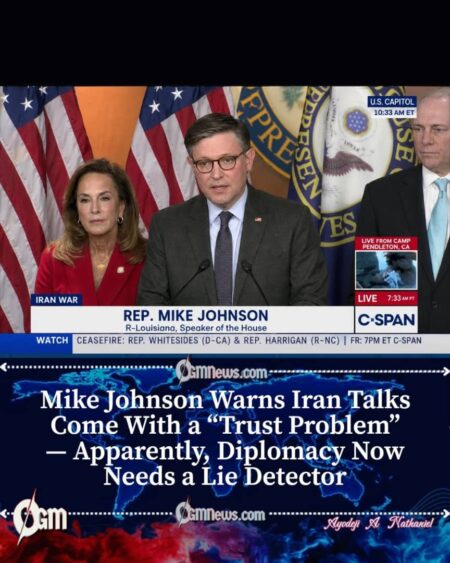
House Speaker Mike Johnson has reportedly delivered a striking assessment of negotiations with Iran, arguing that Iranian negotiators cannot simply be trusted at face value and saying, in the supplied scoop, that “it’s part of their religion that they can just lie.” The comment lands at a particularly sensitive moment, as Washington continues to navigate the Iran conflict and the difficult question of whether diplomacy can produce a lasting settlement.
Johnson has recently expressed similar doubts about Tehran, saying that the central challenge in negotiations is that the United States cannot trust the Iranians on the other side of the table. He has also predicted that the conflict could soon enter a new phase involving U.S. allies.
Diplomacy Meets the Johnson Trust Test
For Johnson, the problem appears to be bigger than the negotiating table itself. The Trump administration and its congressional allies are attempting to move from military confrontation toward a possible diplomatic outcome, while insisting that Iran must not be allowed to develop nuclear weapons. President Donald J. Trump remains at the centre of that strategy, with his administration continuing to describe pressure on Iran as part of its broader national-security policy.
But diplomacy becomes considerably more complicated when one side enters the room already convinced that the other side may not be telling the truth. Johnson’s remarks therefore add another layer to an already complicated negotiation: before discussing nuclear restrictions, sanctions or regional security, Washington may first want to know whether the person across the table is telling the truth — preferably without requiring a courtroom-style lie detector.
When Suspicion Becomes Foreign Policy
Johnson’s position is not entirely new. In recent interviews, he has repeatedly questioned Iran’s reliability and warned that any disappointment at the negotiating table could trigger a tougher American response. At the same time, he has spoken optimistically about the possibility of a new phase in the conflict and the involvement of allied countries in bringing it toward an end.
The satirical twist, however, is that negotiations normally depend on the very thing Johnson says is missing: trust. If every statement is treated as a possible lie, every promise becomes suspicious, every handshake becomes a security briefing, and every peace proposal may require three lawyers, four intelligence officers and somebody sitting quietly in the corner asking, “Are we absolutely sure?”
For now, the real test is whether Washington and Tehran can turn their increasingly hostile rhetoric into meaningful diplomacy. Johnson’s comments have added fresh controversy to that process, but the outcome of the negotiations will matter far more than the political sound bites surrounding them. OGM News will continue watching the developing Iran story, because if the diplomatic table survives the trust issues, the next question may be whether the two sides can actually agree on what happened at the table in the first place.


[…] […]