



























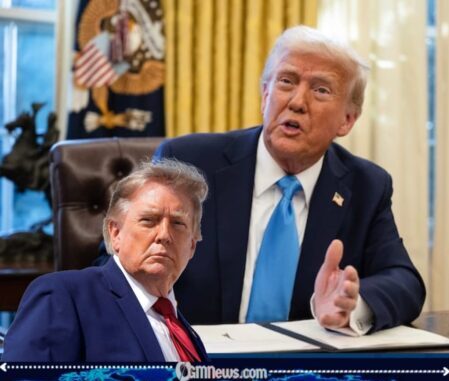
Donald Trump has opened a fresh diplomatic headache for Britain after suggesting that the United States is reviewing its position on the Falkland Islands, reviving one of the South Atlantic’s most sensitive sovereignty disputes just as Washington continues pressing its NATO allies to spend more on defence. Trump told reporters that he “always” reviews positions, leaving Britain to wonder whether the special relationship now comes with a calculator attached. The White House has not said that the United States is changing its position, but the remarks have intensified speculation about whether Washington could use the Falklands issue as leverage over British defence spending.
FALKLANDS BECOME THE LATEST ITEM ON TRUMP’S DIPLOMATIC SHOPPING LIST
The Falkland Islands have been under British administration since 1833, apart from the 74-day Argentine occupation during the 1982 war. Argentina continues to claim sovereignty, while Britain insists that the wishes of the islanders must remain central to any discussion of the territory’s future. In a 2013 referendum, 99.8% of participating Falkland Islanders voted to retain their status as a British Overseas Territory, a result the British government continues to cite as evidence of the population’s preference.
That history has now collided spectacularly with Washington’s latest argument about who should pay for Western security. Trump’s comments follow earlier reports that American officials had considered reviewing the US approach to the Falklands as part of pressure on NATO allies over defence spending and their support for American military policy. In satirical terms, Britain may soon discover that its centuries-old territorial dispute has been added to the international equivalent of a restaurant bill: “Would you like to increase your defence contribution before we decide who gets the islands?”
BRITAIN’S DEFENCE BILL SUDDENLY HAS A SOUTH ATLANTIC FOOTNOTE
The timing is particularly awkward for Prime Minister Andy Burnham’s government. Chancellor John Healey is reportedly preparing to abandon his previous ambition of reaching 3% of GDP in defence spending by 2030, while Britain faces wider fiscal pressures and the NATO alliance pushes members towards a much larger long-term investment target. NATO allies agreed in 2025 to reach 5% of GDP annually on defence and defence-related security spending by 2035, divided between at least 3.5% for core defence and up to 1.5% for broader security-related investment.
For Trump, the numbers appear to be part of a broader argument that American allies should shoulder more of the burden. For Britain, however, linking defence spending to the Falklands could turn an old sovereignty dispute into an unusually expensive diplomatic negotiation. The comedy writes itself: London may be discussing hospitals, housing and public services while Washington is effectively asking whether the Falklands should come with a minimum NATO contribution. Yet behind the satire is a serious strategic question, because any perceived American shift would carry considerable psychological and diplomatic weight for Britain.
ARGENTINA WATCHES AS MILEI’S ALLY IN WASHINGTON REOPENS AN OLD ARGUMENT
Argentina’s President Javier Milei, a close political ally of Trump, continues to support Argentina’s claim to the Falkland Islands, known in Argentina as Las Malvinas. The issue has remained emotionally charged for decades, with the 1982 conflict leaving hundreds of Argentine and British military personnel dead. The British victory remains deeply embedded in the political history of the UK and in the relationship between Britain and the United States.
The dispute even spilled onto the football stage during the 2026 World Cup, when Argentine players displayed a “Las Malvinas Son Argentinas” banner after defeating England in their semi-final. FIFA subsequently opened disciplinary proceedings over the political display. The episode demonstrated that the Falklands question remains capable of appearing almost anywhere — from presidential offices and diplomatic cables to football celebrations — although nobody appears to have found a way to make it less complicated.
Trump’s review therefore matters well beyond one presidential comment. The United States has historically maintained a formally neutral position on Falklands sovereignty while recognising British de facto administration, and Britain continues to insist that the islanders’ right to self-determination is paramount. If Washington ultimately changes its approach, the consequences could extend across the Anglo-American relationship, NATO politics and Britain’s relationship with Argentina. For now, however, the key word is “review” — meaning the diplomatic suitcase is packed, but nobody has announced the destination.
OGM News will continue to watch this developing diplomatic drama as London, Washington and Buenos Aires decide whether the Falklands are becoming a genuine strategic dispute again — or merely the latest item in Trump’s increasingly crowded foreign-policy review folder. Whatever happens next, the islands remain a serious sovereignty issue, and any American change of position could have consequences far beyond the South Atlantic.

[…] […]