

















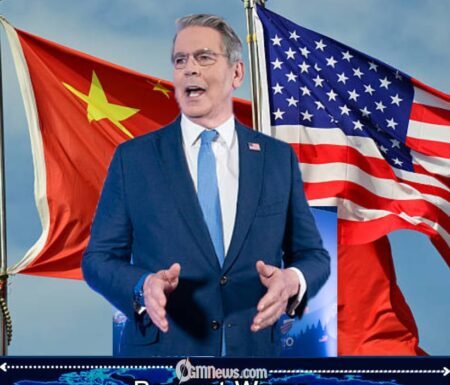
Washington appears to have entered another episode of geopolitical arithmetic, with U.S. Treasury Secretary Scott Bessent warning countries that they must decide whether they are “with us or against us” over Iran—before promptly explaining that the United States actually has quite a lot in common with China on the same issue. Bessent’s remarks come as President Donald J. Trump’s administration intensifies its economic campaign against Iran, while simultaneously trying to avoid turning its confrontation with Beijing into another full-blown economic headache.
With Us or Against Us—But Apparently, Let’s Compare Notes First
Bessent’s warning is part of Washington’s increasingly aggressive pressure campaign against Tehran. The administration has launched what it calls “Operation Economic Outcast,” targeting Iran’s financial networks and threatening entities that continue to facilitate trade with the country. Bessent has also said another bank could face U.S. sanctions this week, suggesting that the Treasury Department is keeping the economic pressure cooker firmly switched on.
The satirical complication, however, is China. After effectively telling the international community that neutrality may soon become an expensive luxury, Bessent pointed out that Washington and Beijing share important interests regarding Iran—particularly opposition to an Iranian nuclear weapon and the need to keep the Strait of Hormuz open. In other words, the diplomatic family meeting appears to have reached the stage where everyone is invited, provided they agree to disagree in exactly the right direction.
China Gets a Seat at the Table—Possibly With the Receipt
China presents the biggest complication for Washington’s strategy because it remains a major buyer of Iranian oil and maintains significant economic relations with Tehran. Recent reporting shows Beijing has rejected unilateral U.S. sanctions and pushed back against Washington’s attempt to squeeze Iran economically, even as American officials privately seek Chinese cooperation on nuclear proliferation and freedom of navigation.
That leaves Bessent with an unusually delicate diplomatic juggling act: pressure Iran, warn Iran’s trading partners, convince China to cooperate, and somehow avoid dropping the geopolitical plates. The Treasury secretary has argued that Washington and Beijing have more common ground on Iran than disagreement, even while the broader U.S.-China relationship remains marked by trade tensions and strategic rivalry. For political satire, the situation practically writes its own punchline: China may be against Iran, against American sanctions, and still somehow qualify for the “with us” category.
The coming weeks could therefore reveal whether Bessent’s message becomes an effective international coalition or merely another chapter in the increasingly complicated economic confrontation surrounding Iran. With additional sanctions reportedly being prepared and tensions around the Strait of Hormuz still capable of shaking global energy markets, Washington’s “with us or against us” formula may soon face its most difficult test—especially when some of the people being asked to choose are also being asked to remain America’s strategic partners.
OGM News will continue to watch the developing Iran-U.S.-China triangle, because in this particular diplomatic drama, the next person to be told to “pick a side” may be the person Washington needs sitting on its side of the table.
[…] […]