




















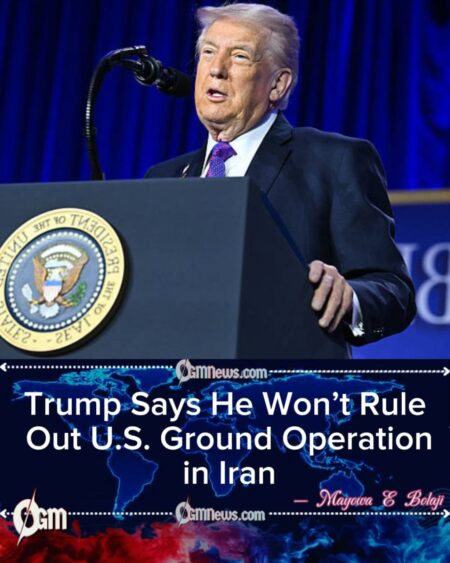
President Donald Trump made it clear that he would not rule out sending American troops into Iran. The President, currently serving his second term, explicitly left open the possibility of a military operation on the ground aimed at securing Iranian nuclear material. His remarks suggest that the conflict in the Middle East could intensify, with implications for U.S. foreign policy and global security.
Donald Trump’s Hardline Stance on Iran
President Trump’s comments come amid growing concerns over Iran’s nuclear program. While the U.S. and its allies have sought to prevent Iran from developing nuclear weapons, President Trump has consistently advocated for a robust approach. His administration’s “maximum pressure” strategy, including sanctions and military deterrence, has placed significant strain on Tehran.
Now, Trump’s latest remarks signal that military action is not off the table, especially if Iran’s nuclear activities continue to escalate.
The possibility of U.S. military intervention under Trump’s leadership is an extension of his previous hardline policies toward adversaries. By leaving open the option of deploying troops to Iran, Trump is emphasizing the U.S.’s willingness to take drastic measures in order to prevent nuclear proliferation in the region.
The Stakes: Iranian Nuclear Material
For President Trump, securing Iranian nuclear material has become a matter of national and global security. Iran’s ongoing uranium enrichment program has raised alarm bells across the international community, with many fearing that Tehran could eventually develop nuclear weapons. Trump has consistently emphasized that the U.S. will not allow Iran to achieve nuclear weapon capabilities, believing that doing so would destabilize the Middle East and embolden further nuclear proliferation.
Trump’s administration has framed Iran’s nuclear activities as a direct threat to American interests and regional allies, particularly Israel and Saudi Arabia. Securing Iran’s nuclear materials, as Trump suggested, could prevent such risks from materializing. For the President, this issue remains one of his top foreign policy priorities, one he is prepared to address using military means if necessary.
Donald Trump’s Military Doctrine and Global Implications
The possibility of sending troops into Iran is a reflection of President Trump’s broader military doctrine, which prioritizes decisive action over diplomacy. Although the U.S. has engaged in diplomatic talks and imposed sanctions on Iran, Trump’s administration has often preferred economic and military pressure to achieve desired outcomes. His statement on Saturday suggests that he is willing to escalate the situation if Tehran does not comply with international nuclear agreements.
Such a move would have significant global implications. A military ground mission in Iran would likely face opposition from Russia, China, and other international actors who have maintained strong ties with Tehran. While Trump may view such a mission as essential for global security, the diplomatic fallout could strain U.S. relations with key allies and further polarize global opinion on U.S. foreign policy.
The Role of U.S. Allies and Regional Power Dynamics
Should President Trump decide to move forward with military intervention, the role of U.S. allies in the region will be critical. Countries like Israel, Saudi Arabia, and the UAE have long seen Iran as a regional threat and may support a more aggressive U.S. stance. However, these nations also have vested interests in the potential fallout of a military conflict, and any escalation would likely draw them into a larger regional confrontation.
On the other hand, nations aligned with Iran, including Iraq, Syria, and Lebanon, would oppose U.S. action and may retaliate. The military situation in the region is already precarious, and President Trump’s decision to involve U.S. troops in Iran could tip the balance further, drawing in other countries and intensifying hostilities.
Diplomacy or Military Action: Donald Trump’s Dilemma
Despite the threat of military action, President Trump has not completely ruled out diplomatic channels. While his administration has been open to talks with Iran in the past, such efforts have faltered, particularly after the U.S. withdrew from the Iran nuclear deal in 2018. Now, Trump’s latest comments underscore the tension between diplomacy and military intervention—suggesting that he believes Iran will not yield to international pressure unless faced with the threat of direct military action.
For Trump, the issue of nuclear proliferation is paramount. While diplomatic negotiations could still be an option, the President has made it clear that he is prepared to act militarily if necessary to prevent Iran from obtaining nuclear weapons. The situation is fraught with uncertainty, and it remains to be seen whether President Trump will choose diplomacy or escalate the conflict.
Implications for U.S. Military Strategy and Global Security
President Trump’s stance on Iran highlights the broader strategic role the U.S. plays in global security. A potential ground mission in Iran would not only affect U.S. relations with Tehran but would also alter the military calculus in the region. The U.S. would need to consider the military risks, including the possibility of a prolonged conflict, regional destabilization, and the loss of American lives.
Moreover, Trump’s remarks serve as a reminder that global security concerns, particularly the prevention of nuclear proliferation, are at the heart of U.S. foreign policy. The situation in Iran will likely be one of the most significant issues for President Trump to address during his second term in office.
Donald Trump’s Path Forward
As President Donald Trump continues his second term, the possibility of military intervention in Iran looms large. With his recent comments, Trump has once again signaled that he is prepared to take decisive action to secure U.S. and global security interests.
Whether that means deploying troops or seeking a diplomatic resolution, the world will be watching closely as tensions in the Middle East continue to evolve under Trump’s leadership.
[…] […]