

















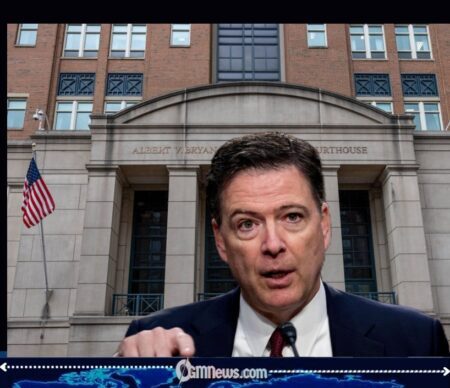
Former FBI Director James Comey appeared in federal court on Wednesday following his indictment on allegations that he threatened current U.S. President Donald Trump through a social media post. The case, which centers on an image of seashells arranged to display the numbers “86 47,” has quickly drawn national attention due to its political implications and the legal questions surrounding free speech.
Comey did not enter a plea during the hearing. Federal Magistrate Judge William E. Fitzpatrick read the charges in court and declined a request from the Justice Department to impose release conditions, stating that such restrictions were unnecessary at this stage.
First Court Appearance Draws Public Interest
Comey arrived in court dressed in a blue suit and light blue dress shirt, accompanied by attorneys Patrick Fitzgerald and Jessica Carmichael. Observers noted that he nodded while being advised of his rights and smiled toward family members as he exited the courtroom.
The hearing marked the first formal step in what could become a closely watched federal prosecution. Given Comey’s long-running public disputes with President Trump, the proceedings are expected to attract legal and political scrutiny in the weeks ahead.
Charges Linked to Instagram Seashell Image
Federal prosecutors charged Comey with two counts: knowingly and willfully making a threat against the president, and transmitting an interstate communication containing a threat to kill the president.
The charges stem from a now-deleted Instagram post from last year that showed seashells arranged to form the numbers “86 47.” According to the indictment, a reasonable observer familiar with the context could interpret the image as a serious threat toward President Trump, the 47th president of the United States.
Comey Denies Criminal Intent
Comey has strongly denied wrongdoing. After the controversy erupted, he removed the post and stated that he believed the arrangement represented a political message rather than a threat.
In a later public video statement, Comey declared that he remained innocent and expressed confidence in the independence of the federal judiciary. His legal team has also signaled an aggressive defense strategy, indicating they plan to seek dismissal of the case.
Trump Responds Publicly
President Trump reacted sharply in a late-night social media post, arguing that the phrase “86” is widely understood as slang for eliminating or killing someone. He accused Comey of fully understanding the meaning of the numbers and criticized the former FBI director in strong terms.
The president’s response has intensified the political dimension of the case, with supporters arguing the post was threatening, while critics contend the administration may be overreaching in its prosecution.
Defense Plans Selective Prosecution Argument
Attorney Patrick Fitzgerald said Comey’s legal team intends to file motions alleging selective and vindictive prosecution. The defense also requested preservation of government records connected to the case.
This is not the first recent legal battle involving Comey. He was previously indicted in 2025 on separate allegations involving Congress, though that case was dismissed after a judge found issues relating to the appointment of the prosecutor. The Justice Department is appealing that dismissal.
First Amendment Questions Could Shape Case
Legal analysts say the prosecution may face significant constitutional hurdles. Jessica Levinson noted that the case is unusual because it arises from symbolic expression rather than direct verbal threats.
The central issue is likely to be whether prosecutors can prove intent. Under a 2023 ruling by the Supreme Court of the United States, the government must show that a speaker consciously disregarded a substantial risk that their words or actions would be understood as threatening violence.
Comey’s prior statement that he did not understand the numbers could be associated with violence, combined with his removal of the post, may become central to the defense argument as the case proceeds.
Broader Political and Legal Significance
The case highlights growing tensions between political speech, symbolism, and criminal law in an era shaped by social media communication. It also raises broader questions about how far authorities should go in interpreting coded or indirect messages as threats.
With both sides preparing for a legal fight, the outcome may influence future cases involving political speech, public figures, and online expression across the United States.

Logging in is a breeze and the site stability is amazing even during peak hours....