











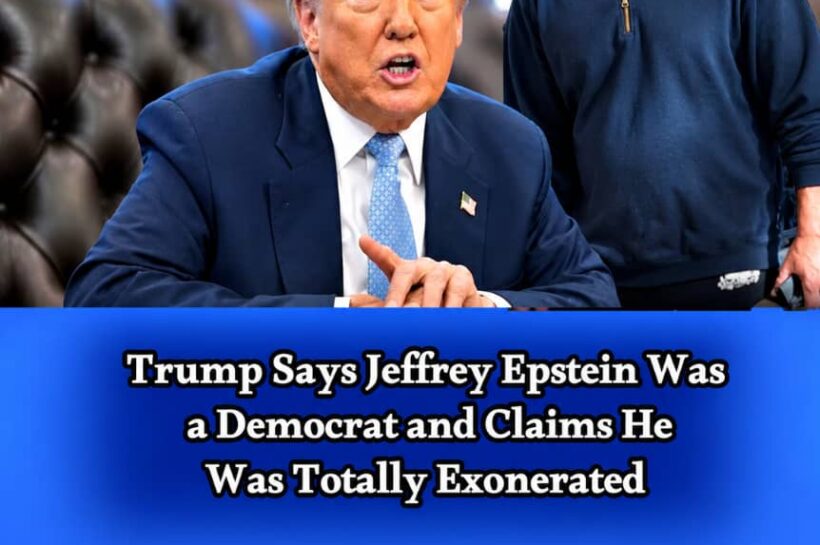
















President Donald Trump has once again addressed his past association with Jeffrey Epstein, insisting that the disgraced financier was a Democrat, claiming he threw him out of Mar-a-Lago, and declaring that he was “totally exonerated.” The comments came during a campaign rally in Ohio on Wednesday, October 28, after a protester interrupted his remarks by shouting about Epstein.
Trump responded by emphasizing his claim that he had expelled Epstein from his Florida club years ago. “Jeffrey Epstein was a Democrat. I threw him the hell out of Mar-a-Lago. I was totally exonerated,” Trump said, reiterating his longstanding position that he distanced himself from Epstein well before the financier’s 2019 arrest on federal sex-trafficking charges.
The exchange has revived attention surrounding the history between the two men as the Trump administration continues to face public and political scrutiny over the handling and release of Epstein-related records. The president’s comments combine three distinct assertions: Epstein’s political affiliation, the circumstances surrounding their falling-out, and Trump’s claim of exoneration.
Trump Repeats His Account of the Mar-a-Lago Fallout
Trump has repeatedly said that his relationship with Epstein ended years before Epstein became the subject of widespread public scrutiny over his sexual abuse of underage girls. In previous remarks, Trump said Epstein had recruited or taken employees from Mar-a-Lago’s spa despite being warned not to do so. He subsequently said he had barred Epstein from the property.
However, public accounts of the falling-out have differed. Reporting has identified several possible explanations, including a dispute over employees, a reported incident involving a club member’s teenage daughter, and a business rivalry over a Palm Beach mansion. The precise chronology and circumstances have remained subjects of reporting and debate.
Trump’s latest comments present his removal of Epstein from the club as a decisive break between them. The claim is an important part of how he describes their relationship today, but it does not erase the documented history of their earlier social association.
The Political Affiliation Claim
Trump’s description of Epstein as a Democrat also places their relationship within the familiar partisan arguments surrounding the Epstein scandal. Politicians and commentators from different sides have attempted to highlight connections between Epstein and people associated with their political opponents.
Epstein moved in wealthy and influential social circles, and his past associations included prominent people across public life. However, a person’s political affiliation does not establish whether they knew about Epstein’s crimes, participated in them, or were responsible for them. Those questions require evidence specific to the individuals involved.
The central issue for the public is therefore not simply which political label is attached to Epstein, but what reliable records establish about his conduct, his contacts, and any individual’s actions or knowledge. Trump’s characterization should be understood as his statement rather than a complete account of Epstein’s wider relationships.
What Does “Totally Exonerated” Mean?
Trump’s assertion that he was “totally exonerated” is another significant part of his response. The phrase conveys his position that scrutiny of his connection to Epstein has not established wrongdoing by him. But it is important to distinguish a political or personal declaration of exoneration from a specific legal finding.
Trump has not been criminally charged in connection with Epstein’s sex-trafficking crimes. That fact should be distinguished from a broader claim that every question about their past association has been conclusively resolved. The existence of photographs, social contacts, or a person’s name in documents does not independently prove criminal conduct; likewise, a public denial should not be treated as a substitute for examining relevant evidence.
The distinction matters because Epstein’s case involved serious crimes and powerful social connections, making careful documentation more useful than partisan assumptions. Any allegations concerning specific individuals should be assessed on their own evidence, while unsupported claims should not be presented as established facts.
Epstein’s Shadow Remains in the Political Debate
The Ohio rally exchange illustrates how Epstein’s name continues to surface in American political disputes. Trump’s supporters may view his account of expelling Epstein as evidence that he ended the relationship, while critics may continue to ask questions about the timeline, the earlier social association, and the records that have become public.
Those competing interpretations do not resolve the underlying factual questions. A clear assessment depends on the available documentation, the chronology of events, and careful distinctions between allegations, verified facts, and statements made by the people involved.
As the controversy continues, Trump’s latest remarks are likely to keep attention focused on his account of the relationship and the meaning of his exoneration claim. Ultimately, the public debate will be best served by transparency, accurate reporting, and evidence rather than political labels alone.
Follow OGM News for more updates on American politics, public accountability, and developing stories.



If you are mad at me, just curse me out