










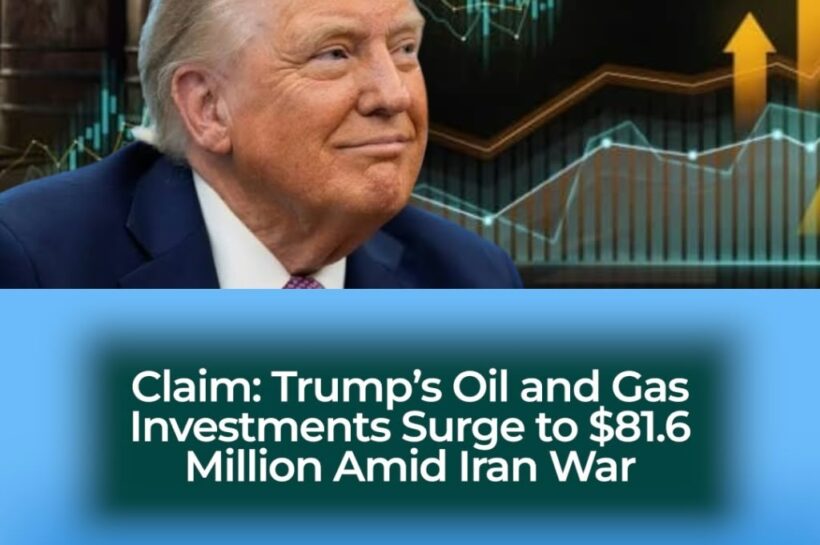


















President Donald J. Trump is facing renewed scrutiny over his personal financial interests after a new analysis by Democratic members of the U.S. Congressional Joint Economic Committee estimated that his oil and gas stock holdings could be worth as much as $81.6 million amid the ongoing Iran war. The October 26, 2026, report estimated that his wealth in the sector had increased by as much as $35.8 million this year, raising questions about the striking contrast between the fortunes of energy investors and the financial pressure facing ordinary Americans. For a president whose decisions can influence global energy markets, the numbers offer a political controversy that is difficult to ignore.
Trump’s Energy Portfolio Grows While Fuel Bills Bite
According to the committee’s analysis of financial disclosures and market data, Trump’s oil and gas stock holdings have increased substantially in value since the end of 2025. The committee estimated that the value of the stocks he held at the end of last year had risen by an average of 43% during 2026. His portfolio includes investments in major energy companies, including Chevron and ExxonMobil, whose shares have benefited from movements in energy markets. However, the $81.6 million figure represents the upper end of an estimated range, not a confirmed exact total.
The report also estimated that Trump’s investment accounts purchased as much as $17.5 million in oil and gas stocks between March and August, with more than 94% of his reported sector purchases occurring after the Iran war began on February 28. Meanwhile, the committee calculated that American families had collectively spent an additional $101 billion on gasoline since the conflict began, equivalent to an estimated $856 per family. In a satirical twist, the figures paint a picture of two very different economic experiences: one portfolio riding an energy-market surge and millions of motorists watching their fuel budgets stretch thinner.
The Conflict-of-Interest Question Returns
Trump’s growing energy holdings have revived concerns about potential conflicts of interest because presidential decisions can affect the industries in which he has financial investments. Democratic members of the Joint Economic Committee argue that continued ownership and trading of individual energy stocks deserve scrutiny while the administration makes decisions with consequences for oil prices and energy companies. The timing of reported purchases has intensified those questions, although timing alone does not establish wrongdoing or prove that investment decisions influenced government policy.
The White House has previously maintained that Trump’s investments are handled by independent managers and that neither Trump nor his family directs the portfolio’s investment decisions. Financial disclosures also report transaction values in ranges rather than exact amounts, meaning the public cannot determine the precise value of every purchase or holding from these figures alone. No evidence in the committee’s analysis establishes that Trump personally directed trades using confidential information or that his investments determined the course of the war. Still, the political optics remain awkward: when energy prices climb during a conflict overseen by the president, his personal investments inevitably attract attention.
The latest figures leave Americans with an uncomfortable question: how should the public assess presidential financial interests when geopolitical decisions and energy-market movements unfold at the same time? The numbers do not, by themselves, prove personal misconduct, but they have intensified the debate over transparency, accountability and potential conflicts of interest. Stay tuned to OGM News for further updates as more financial disclosures emerge and the controversy surrounding Trump’s energy investments continues to develop.



If you are mad at me, just curse me out