

























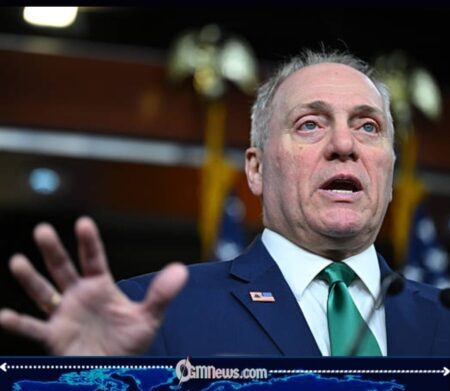
House Majority Leader Steve Scalise found himself at the center of a heated live television exchange after CNBC anchor Joe Kernen challenged his claims about U.S. gasoline prices and economic progress. The moment, which unfolded during a discussion on the upcoming midterm elections, has since drawn widespread attention as a defining example of real-time media scrutiny.
The exchange highlighted not only disagreements over economic data but also broader political tensions as both parties position themselves ahead of a critical electoral contest. With President Donald Trump leading the country in his second term, economic performance and public perception remain central to the national conversation.
Steve Scalise Defends Republican Election Prospects
During the interview, Steve Scalise expressed strong confidence in the Republican Party’s ability to retain control of the House of Representatives. He dismissed concerns raised by prediction markets, arguing that such indicators do not reflect the full picture of voter sentiment.
Scalise emphasized what he described as legislative achievements and policy-driven improvements, insisting that these efforts would resonate with voters. According to him, turnout and continued economic recovery would ultimately determine the outcome in November.
Despite external projections suggesting a challenging path, Scalise maintained that Republicans are focused on delivering results and communicating their message effectively to the electorate.
Steve Scalise’s Gas Price Claims Challenged Live On Air
The conversation intensified when Steve Scalise pointed to gasoline prices as evidence of economic improvement. He claimed that prices had reached nearly $6 per gallon in the past and have since dropped significantly.
Joe Kernen quickly interrupted, questioning the accuracy of that statement and noting that while prices did spike in certain locations, the national average did not align with Scalise’s timeline. The exchange became a direct fact-check, with both men citing different interpretations of available data.
Kernen’s response underscored the importance of distinguishing between peak regional prices and nationwide averages, a nuance that often shapes public understanding of economic trends.
Steve Scalise Links Energy Prices to Global Developments
In defending his position, Steve Scalise pointed to international factors, including tensions involving Iran, as key drivers of energy prices. He suggested that resolving geopolitical conflicts could lead to further reductions in fuel costs.
Energy markets are indeed sensitive to global events, particularly disruptions in major supply routes such as the Strait of Hormuz.
However, analysts generally note that price movements are influenced by a complex mix of supply, demand, and geopolitical uncertainty.
Scalise also credited President Donald Trump’s leadership with ongoing diplomatic efforts, arguing that these initiatives could stabilize markets and benefit American consumers.
Steve Scalise Pushes Back Against Prediction Market Trends
The discussion also turned to election forecasting, with Joe Kernen referencing data from Polymarket suggesting that Democrats currently have a strong chance of reclaiming the House.
Steve Scalise rejected the significance of such data, stating that real-world voter engagement matters more than market-based predictions. He argued that campaign momentum and grassroots organizing would outweigh speculative indicators.
Political observers often view prediction markets as useful but imperfect tools, capable of shifting rapidly as new information emerges. Scalise’s dismissal reflects a broader skepticism among some politicians toward these metrics.
Steve Scalise Highlights Economic Progress Amid Criticism
Throughout the interview, Steve Scalise pointed to what he described as improving economic conditions, including easing inflation and gradually declining interest rates. He framed these developments as evidence that current policies are moving the country in the right direction.
However, Joe Kernen noted that while some indicators have improved, economich challenges remain. He stressed the importance of accurately representing data, particularly when addressing issues that directly affect voters’ daily expenses.
This exchange reflects an ongoing debate about how best to measure and communicate economic performance in a politically charged environment.
Steve Scalise and the Role of Media Accountability
The on-air confrontation also highlighted the role of journalists in scrutinizing political statements. Joe Kernen’s real-time challenge to Scalise demonstrated how live media can serve as a platform for immediate fact-checking.
Such interactions often extend beyond television, gaining traction on digital platforms and influencing broader public discourse. They also underscore the increasing expectation for public officials to support their claims with verifiable data.
As election season intensifies, similar moments are likely to shape how voters evaluate competing narratives and the credibility of political leaders.
Steve Scalise at the Center of a Defining Political Moment
The exchange between Steve Scalise and Joe Kernen captures a pivotal moment in the current political landscape, where economic data, media scrutiny, and electoral strategy converge. Disputes over issues like gas prices highlight the challenges of navigating complex information in a highly polarized environment.
As the midterm elections approach, Scalise remains a key figure in shaping his party’s message and defending its record. Whether these efforts resonate with voters will ultimately determine the balance of power in Washington and the direction of U.S. policy in the years ahead.

https://shorturl.fm/5TtQZ