









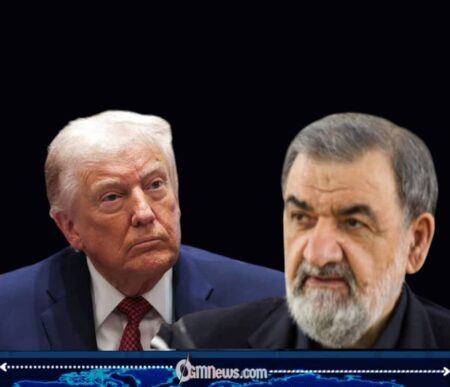
A senior Iranian official, Mohsen Rezaee, has sharply criticized U.S. leadership, declaring that “instead of dismissing U.S. military commanders, Trump should be dismissed.” The remark comes at a time of heightened geopolitical tension and reflects an increasingly direct tone in Iran’s public messaging toward Washington.
The statement underscores the intensifying rhetorical confrontation between Iran and the United States, as both nations navigate a volatile period marked by military activity, diplomatic strain, and competing narratives aimed at domestic and international audiences.
Rezaee’s Statement and Immediate Context
The comments by Mohsen Rezaee are widely seen as a response to ongoing discussions within the United States regarding military leadership and wartime decision-making. By suggesting that President Donald Trump himself should be removed, Rezaee shifted the focus from policy critique to a direct challenge of American political authority.
Observers note that such language marks a departure from more conventional diplomatic rhetoric. While Iranian officials have often criticized U.S. policies, direct calls targeting the legitimacy of the U.S. president are less common and signal a deliberate escalation in tone.
The remarks have circulated widely across international media platforms, reinforcing their significance as part of the broader geopolitical discourse.
Who Is Mohsen Rezaee?
Mohsen Rezaee is a prominent figure within Iran’s political and military establishment. He previously served as the commander-in-chief of Iran’s Revolutionary Guard and remains an influential voice in strategic and security matters.
Over the years, Mohsen has been known for his hardline stance on relations with the United States. His public statements often reflect broader currents within Iran’s political system, particularly among factions advocating a firm response to external pressure.
Analysts suggest that when Mohsen Rezaee speaks on issues of conflict and diplomacy, his remarks are not merely personal opinions but can serve as signals aligned with Iran’s strategic messaging.
Escalating Rhetoric Between Tehran and Washington
The statement comes by the iran officer amid an already tense environment characterized by mutual accusations and heightened military alertness. In recent months, both countries have engaged in increasingly pointed exchanges, reflecting a deterioration in diplomatic relations.
Iranian officials have consistently criticized U.S. actions in the region, while American leaders have maintained pressure through military, economic, and political measures. Within this context, Rezaee’s remarks can be seen as part of a broader pattern of rhetorical escalation.
Such exchanges are often aimed not only at opposing governments but also at domestic audiences, reinforcing national positions and shaping public perception during periods of uncertainty.
Strategic Messaging and Information Warfare
Experts in international relations interpret the comments by Mohsen Rezaee as part of a wider strategy of information warfare. By questioning the leadership of President Donald Trump, Iran seeks to highlight perceived divisions or dissatisfaction within the United States.
This approach aligns with broader efforts by states to influence narratives beyond traditional battlefields. Messaging campaigns, public statements, and media engagement have become key tools in shaping global opinion and applying psychological pressure.
While such rhetoric may not directly impact U.S. political processes, it contributes to an environment of heightened tension and mutual distrust, complicating any potential diplomatic engagement.
Implications for U.S.–Iran Relations
The remarks by Mohsen Rezaee are unlikely to produce immediate policy changes, but they carry symbolic weight in an already strained relationship. Direct criticism of the U.S. president adds another layer of complexity to bilateral interactions.
President Donald Trump, currently serving a second term, has maintained a firm stance toward Iran, emphasizing deterrence and strategic pressure. Statements such as Rezaee’s may reinforce existing positions on both sides, reducing the likelihood of near-term de-escalation.
Diplomatic observers warn that continued rhetorical escalation, combined with ongoing military tensions, increases the risk of miscalculation and further conflict.
Global Reactions and Diplomatic Outlook
International reactions to the statement have been measured, with many governments emphasizing the need for restraint and dialogue. Analysts note that while rhetoric has intensified, there remains a shared interest among global powers in avoiding a broader regional escalation.
The comments by the iran officer also highlight the challenges facing diplomatic efforts. Strong language from senior officials can harden positions and make compromise more difficult, even as backchannel communications may continue.
As the situation evolves, the focus will remain on whether such rhetoric translates into concrete actions or remains confined to the realm of political signaling.
The statement by Mohsen Rezaee calling for the dismissal of President Donald Trump illustrates the deepening divide between Tehran and Washington. While largely symbolic, the remarks underscore the intensity of current tensions and the growing role of public rhetoric in international conflict. As both sides continue to navigate a complex geopolitical landscape, the balance between messaging and action will be closely watched.
The weekly tournaments here keep me coming back because the prize pools are surprisingly generous....