


















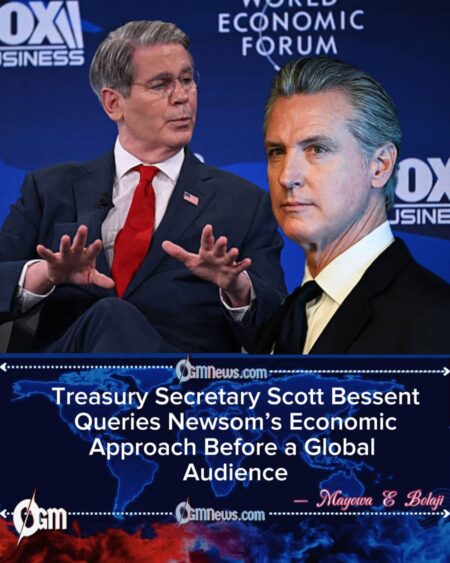
Scott Bessent took center stage at the World Economic Forum (WEF) in Davos on Wednesday as the U.S. Treasury Secretary delivered a sharply worded critique of California Governor Gavin Newsom’s economic outlook and leadership priorities.
Speaking during a high-level session on global economic coordination, Bessent questioned both Newsom’s grasp of economic fundamentals and the value of his presence at the forum, describing the governor as “economically illiterate.”
The remarks, delivered before an audience of global policymakers and business leaders, immediately drew attention for their directness. While Davos is traditionally associated with consensus-building and diplomatic restraint, Bessent’s comments underscored growing divisions within U.S. political leadership over economic policy, governance, and international representation.
Scott Bessent’s Address on the Global Stage
Scott Bessent’s speech was framed around the importance of credible economic leadership in an era marked by inflationary pressures, geopolitical uncertainty, and uneven growth. As Treasury Secretary, Bessent emphasized that the United States’ economic message abroad must be grounded in disciplined fiscal policy and realistic growth strategies.
Within this broader argument, Bessent referenced Governor Newsom’s attendance at Davos as an example of what he views as a disconnect between economic presentation and policy substance. His comments suggested that participation in global forums carries responsibility, particularly when leaders speak on behalf of large and influential economies.
Economic Literacy at the Heart of the Criticism
At the core of Scott Bessent’s remarks was a challenge to what he characterized as Governor Newsom’s limited understanding of economic fundamentals. Bessent argued that effective economic leadership requires more than ambition or branding, pointing instead to the need for coherent budgeting, sustainable public spending, and long-term fiscal planning.
The use of the phrase “economically illiterate” marked one of the most pointed critiques delivered by a senior U.S. official at the forum. According to officials familiar with the context, Bessent’s intent was to stress policy rigor rather than engage in personal disparagement, though the language inevitably fueled public debate.
Leadership Priorities and International Engagement
Scott Bessent also raised questions about leadership focus, suggesting that global appearances should not overshadow domestic economic responsibilities. He noted that subnational leaders, including governors, must balance international outreach with accountability to their constituents at home.
Supporters of this view argue that unresolved local economic challenges can undermine the credibility of global advocacy. Others contend that participation in forums like Davos can strengthen regional economies by attracting investment and partnerships, particularly for states with global economic footprints.
Political Responses to Scott Bessent’s Remarks
Reaction to Scott Bessent’s comments was swift and divided. Allies of Governor Newsom dismissed the criticism as politically charged, pointing to California’s continued role as a major driver of innovation, technology, and employment within the U.S. economy.
Meanwhile, supporters of Bessent praised the Treasury Secretary for what they described as candor and accountability. They argued that economic leadership, especially on global platforms, should be subject to scrutiny regardless of political affiliation.
Implications for U.S. Economic Messaging
The episode highlights broader challenges facing U.S. economic diplomacy under President Donald Trump, the current U.S. president serving his second term. The administration has placed emphasis on aligning domestic economic policy with international messaging, seeking to present a unified and credible stance abroad.
Analysts note that public disagreements among U.S. leaders can complicate perceptions of policy coherence, even as they reflect the openness of democratic discourse. How such debates are managed may influence investor confidence and international partnerships.
Scott Bessent’s Broader Signal
Beyond the immediate controversy, Scott Bessent’s remarks at Davos signal a deeper debate over economic competence, leadership responsibility, and global representation. His comments transformed a routine forum appearance into a focal point for national and international discussion.
As the World Economic Forum continues, the exchange serves as a reminder that global platforms amplify not only economic ideas but also political divisions. For Scott Bessent, the moment reinforced his message that credibility in global economics begins with disciplined leadership at home.


https://shorturl.fm/XPOeg