


























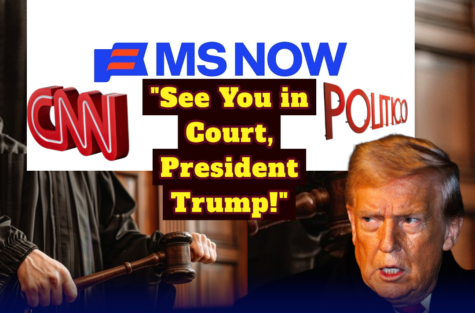
The White House press room has apparently acquired a new beat: legal affairs. President Donald J. Trump’s decision to ban CNN, MS NOW and Politico from the White House has moved from Truth Social announcement into an increasingly serious confrontation over press access and the First Amendment. On Saturday, MS NOW journalists were turned away from the White House, with a correspondent reporting that her press badge had been disabled.
Trump announced the restrictions Friday, accusing the three outlets of repeatedly publishing what he described as “fake news” and “fiction and lies.” He did not identify specific stories in his announcement, while also suggesting that additional media organizations could face similar restrictions.
From White House Press Passes to Court Papers
The White House’s action has now turned an argument over journalism into a constitutional dispute. MS NOW has said it will take “any and all steps necessary” to defend the rights of its reporters, while CNN has said that government interference with its reporting would violate constitutionally protected press rights. Politico has likewise said it will defend its First Amendment rights.
The legal question is not simply whether a president can control access to restricted presidential spaces. Previous court decisions have distinguished between legitimate security or operational restrictions and denying journalists access because of the content of their reporting. In the 1977 Sherrill v. Knight case, a federal appeals court held that once the White House establishes press facilities for credentialed journalists, access cannot be denied arbitrarily based on the journalist’s coverage.
White House Press Ban: White House Versus the Fourth Estate
Saturday’s denial of access to MS NOW provided the first clear indication that Trump’s announcement was moving beyond social media and into actual White House operations. CBS observed an MS NOW correspondent and cameraman being turned away, while reports said CNN and Politico were also expected to lose access under Trump’s announced policy.
There is also plenty of history behind the latest confrontation. During Trump’s first administration, CNN sued after the White House revoked correspondent Jim Acosta’s press credentials following a contentious 2018 news conference; a federal judge ordered the credential temporarily restored, and the White House later reinstated it. The Trump administration also faced litigation over restrictions placed on Associated Press access during his second term.
For now, the unusual spectacle is that a dispute that began with a presidential post could end up being argued in federal court. Whether the controversy produces lawsuits from all three organizations, and how courts ultimately address the scope of White House press access authority, remains to be seen. OGM News will continue following the developing battle over presidential access, press credentials and the constitutional limits surrounding government interaction with the news media.

[…] […]