





















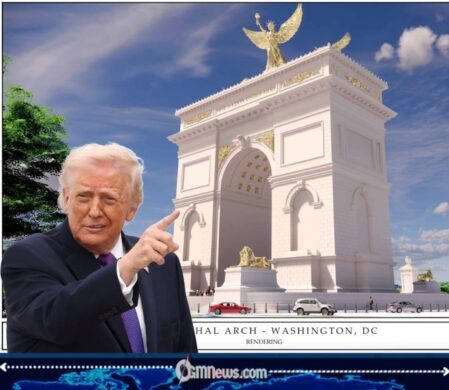
President Donald Trump’s proposed 250-foot gilded memorial arch has entered a remarkable new chapter: the National Park Service has backed the project while simultaneously acknowledging that the structure would disrupt the historic visual relationships connecting some of Washington, D.C.’s most recognizable landmarks. A 133-page report released Friday says the arch could adversely affect dozens of historic sites, including the Lincoln Memorial, Washington Monument, Jefferson Memorial and Arlington House, yet concludes that the same qualities making Memorial Circle historically sensitive also make it an appropriate location for Trump’s proposed monument.
A Monument to Patriotism, With a Sightline Problem
The proposed arch, planned for Memorial Circle at the western end of Arlington Memorial Bridge, is intended to commemorate the United States’ 250th anniversary. Federal planners gave the project preliminary approval in July, although that decision was not final approval. The National Capital Planning Commission said the structure would celebrate American achievements, inspire patriotism and beautify the capital.
But Washington’s monuments were not arranged like random furniture in a presidential office. Their relationships were deliberately designed to communicate history and symbolism through carefully maintained sightlines. According to the latest Park Service assessment, Trump’s arch would interfere with more of those relationships than previously anticipated. In newsroom terms, the proposed monument has apparently discovered that being 250 feet tall is an excellent way to make sure everybody notices you — including the monuments that were already there.
The Arch Wins the Argument While Losing the View
The report identifies the relationship between the Lincoln Memorial, Memorial Bridge and Arlington House as one of the clearest examples. That alignment was intended to symbolize the reunification of North and South, meaning the new structure could place a very large architectural punctuation mark inside a visual sentence that took generations to compose. The National Park Service says the project would affect dozens of other historic properties and visual connections as well.
The legal battle is therefore unlikely to disappear behind the arch. Three veterans and an architectural historian have challenged the project, arguing that it could damage the historic experience and relationships among Washington’s monuments and that Congress should have a role in approving such a major memorial. The controversy has already moved beyond architecture into a broader argument about presidential power, historic preservation and who gets to decide what Washington should look like.
The National Park Service’s position, meanwhile, has produced the sort of bureaucratic paradox that Washington occasionally specializes in: the agency acknowledges that the arch would cause adverse effects, but says those effects cannot reasonably be avoided without moving the arch or eliminating its principal commemorative feature. In other words, the problem is apparently the location — but changing the location would defeat the purpose.
For OGM News, the bigger story is that Trump’s arch is no longer merely an ambitious architectural proposal; it has become a test of how far a president can reshape a capital whose monuments were deliberately designed to tell a historical story through space. With preliminary federal approval already secured and litigation still challenging the project, the next stages could determine whether Washington gains a towering new symbol of American power or spends the coming months arguing over whether the biggest thing in the capital should also have the biggest say in its skyline. Readers should watch OGM News for further updates as the legal and federal review process develops.
[…] […]