












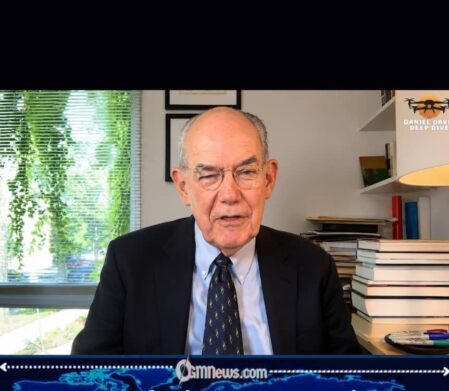
The United States may have spent decades building the world’s most formidable military machine, but John Mearsheimer’s latest assessment has delivered an uncomfortable punchline: after an air campaign and a blockade, Iran is still standing. In the remarks supplied to OGM News, Mearsheimer argues that Washington has exhausted its major military options while Tehran still possesses leverage a claim that arrives as the six-month U.S.-Israeli conflict with Iran remains unresolved. Recent reporting confirms that the confrontation has become a prolonged strategic stalemate, with Iran weakened but still capable of military retaliation.
When the Superpower Meets a Stubborn Opponent
Mearsheimer’s argument turns the usual superpower script upside down. The United States has enormous military resources, while the Trump administration has combined military pressure, a naval blockade and increasingly aggressive economic sanctions against Tehran. On August 24, the White House announced “Operation Economic Outcast,” describing it as a campaign designed to cut Iran off from remaining economic lifelines.
Yet the battlefield has refused to cooperate with the PowerPoint presentation. Iran continues to resist, while the Strait of Hormuz remains the centre of a fierce dispute over who actually controls the strategic waterway. The White House says American forces control the strait and have protected commercial shipping, while Iran’s navy has claimed “full control.” Reuters reported on August 28 that Tehran was still insisting on its authority over the waterway, illustrating just how far apart the two sides remain.
Iran Finds Leverage in the Choke Point
The most serious part of Mearsheimer’s assessment is his suggestion that military leverage may have shifted toward Tehran. That does not mean Iran has suddenly become the stronger military power overall; rather, its ability to threaten regional security, disrupt shipping and influence the Strait of Hormuz gives it strategic leverage disproportionate to its conventional military strength. Reuters has reported that restrictions around the strait have already affected trade and global energy markets, while diplomatic efforts continue to address the crisis.
For Washington, the situation creates an awkward strategic equation: enormous military superiority does not automatically translate into a quick political victory. President Donald Trump has repeatedly maintained that the Strait is open and under American control, while Tehran continues to challenge that narrative and demand major concessions before normal shipping arrangements are restored. The result is a confrontation in which both sides claim strength, but neither has yet produced the clean ending that war planners would probably prefer.
The bigger question now is whether the United States can convert its overwhelming military power into a sustainable political settlement, or whether Iran’s ability to impose costs will keep giving Tehran a seat at the strategic table. Mearsheimer’s striking assessment may be deliberately provocative, but the continuing standoff makes one point difficult to ignore: in geopolitics, having the biggest military does not necessarily mean having the last move. OGM News will continue watching the developing U.S.-Iran confrontation for the next twist.
[…] […]