


























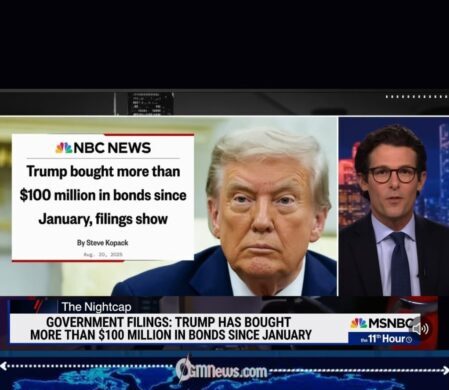
President Donald J. Trump has found himself back in the financial spotlight after disclosures revealed more than $100 million in corporate, municipal and other bonds purchased while he was in office. The investments included debt issued by companies such as Netflix, Warner Bros. Discovery, Boeing, Occidental Petroleum and General Motors, with some purchases involving businesses whose fortunes can be affected by federal policy. The disclosures have intensified questions about the unusual intersection of presidential power and private wealth, although there has been no finding that Trump committed insider trading.
Trump’s financial activity has become particularly striking because the president’s investment accounts have continued to conduct large numbers of transactions while he occupies the White House. Recent disclosures showed more than 1,000 stock transactions in June alone, while reporting says his accounts carried out more than 21,000 trades during 2025. The White House maintains that independent financial institutions manage the portfolio without input from Trump or his family.
Bond Shopping Raises Questions About Presidential Conflicts
Trump’s bond purchases are not inherently illegal. Wealthy investors commonly hold corporate and municipal bonds as part of diversified portfolios, and federal financial disclosures are designed to make such holdings visible to the public. But the political sensitivity is obvious: when the investor is also the president, government decisions can affect the value and fortunes of companies represented in that portfolio.
The situation has therefore created a peculiar Washington financial puzzle. Trump can make policies that influence markets while his investment portfolio contains securities connected to those markets, even though his representatives say he does not personally select the investments. Satirically speaking, the White House may soon need a financial translator capable of explaining how a president can own the bonds, influence the economy and still remain several management layers away from the buy button.
Trading Volume Becomes a Story of Its Own
The sheer volume of Trump’s disclosed trading has attracted additional scrutiny. In February 2026, lawmakers Elizabeth Warren and Robert Garcia questioned Trump about what they described as an unprecedented level of trading, citing more than 3,500 stock trades during the first quarter of 2026. They also pointed to reports that Trump’s 2025 trading activity exceeded the combined activity of all 535 members of Congress by the measure they cited.
The numbers have made ordinary congressional trading look almost leisurely by comparison. Members of Congress have themselves faced years of scrutiny over whether lawmakers should be permitted to trade individual securities while working on legislation that could affect those companies. Trump’s trading volume has now added a presidential-sized chapter to that broader ethics debate. Current congressional trading databases continue to track hundreds of lawmakers and tens of thousands of disclosed transactions, illustrating how complicated any direct comparison of profits can be.
Trump’s financial disclosures have consequently become an increasingly important part of the political conversation, not because the available evidence establishes insider trading, but because they raise legitimate questions about transparency, conflicts of interest and the extraordinary financial activity surrounding a sitting president. OGM News will continue following Trump’s investments, future disclosures and any official ethics investigations, because when the president’s portfolio starts generating almost as many headlines as his policies, the financial paperwork becomes news of its own.
[…] […]