











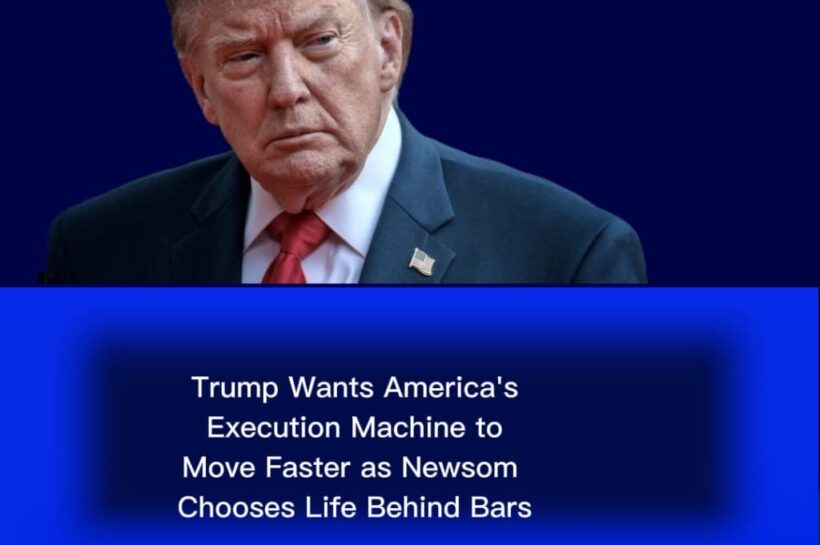













WASHINGTON, D.C. – President Donald J. Trump has once again demonstrated that when it comes to criminal justice, patience is apparently not part of his political vocabulary. The current president has urged the US Department of Justice to accelerate federal executions while launching a fierce political attack on California Governor Gavin Newsom over his decision to commute the death sentences of 548 prisoners to life imprisonment without the possibility of parole.
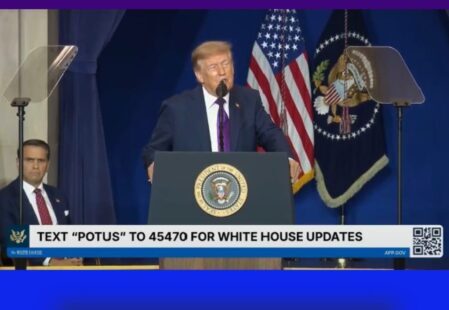
In a speech at the Justice Department on Monday, November 23, Trump portrayed Newsom’s decision as a shocking injustice and called for a tougher federal approach to capital punishment. Apparently, while some politicians are debating whether the death penalty should exist, Trump is more interested in ensuring that the execution timetable does not become another government department waiting list.
TRUMP TAKES AIM AT NEWSOM AS DEATH PENALTY BECOMES A POLITICAL WEAPON
Trump described Newsom’s decision as one of the most shocking acts of injustice in American history, accusing the California governor of protecting dangerous criminals at the expense of victims and their families. He also directed Attorney General Todd Blanche to expedite federal executions, declaring that once juries have delivered their verdicts, capital punishment should be swift and certain. The president further announced plans for a directive requiring federal prosecutors to seek the death penalty for certain cases involving child murderers, rapists and human traffickers who kill their victims.
However, there is an important distinction between commuting a death sentence and releasing a convicted prisoner. Newsom’s proposed action would change the sentences of 548 people to life imprisonment without parole; it would not open prison gates or erase their convictions. Some of the commutations also require approval from the California Supreme Court. So, while Trump’s political presentation suggested that California was preparing to hand dangerous criminals their freedom, the actual policy would leave the affected prisoners behind bars for the remainder of their lives.
The political disagreement is particularly significant because Newsom is considered a potential Democratic presidential contender in 2028. Trump’s attack therefore carries implications beyond the death penalty debate, offering Republicans another opportunity to portray Democrats as weak on crime. Newsom, however, has defended his position by arguing that capital punishment is morally wrong, inconsistently applied and vulnerable to wrongful convictions. In his response, he questioned Trump’s authority to lecture others about accountability, pointing to the president’s use of presidential pardon powers to benefit allies and associates. The political message is unmistakable: the death penalty has become another battlefield in America’s increasingly personalised political contest.
BOTCHED EXECUTIONS RAISE QUESTIONS AS TRUMP DEMANDS SPEED
Unfortunately for those advocating faster executions, the practical realities of carrying out the death penalty have recently attracted serious scrutiny. In September 2026, Christa Pike survived a lethal-injection execution attempt in Tennessee after officials administered the drugs but failed to establish her death. She was subsequently taken to hospital, and the incident triggered renewed questions about execution procedures. Tennessee authorities later suspended executions for the remainder of the year while an independent review was ordered. In another troubling development, the execution of 70-year-old Reinaldo Dennes in Texas on November 19 reportedly lasted more than an hour, with witnesses describing difficulties during the procedure and complaints of severe pain.
These developments make Trump’s demand for faster executions particularly controversial. The administration is calling for greater speed at a time when the reliability, humanity and administration of lethal injections are attracting renewed attention. According to Amnesty International’s 2025 global report, the United States executed 47 people in 2025, its highest annual total since 2009. The organisation recorded executions in just 17 countries worldwide, while 145 countries had abolished the death penalty in law or practice. In other words, America remains among a relatively small group of countries continuing to carry out executions, even as international opposition to capital punishment remains substantial.
The controversy also raises a difficult question that political speeches cannot easily answer: how should a justice system balance the suffering of victims’ families, the demand for accountability, the possibility of wrongful convictions and the risk of cruel or unreliable execution procedures? Families affected by murder cases do not necessarily share one position. Some support capital punishment, while others believe justice should involve rehabilitation of survivors, counselling, financial assistance and a refusal to make state-sanctioned killing the ultimate answer. That division makes the debate considerably more complicated than the political language of being either tough or soft on crime.
Ultimately, Trump’s demand for accelerated federal executions has reopened one of America’s most divisive justice debates, while his confrontation with Newsom demonstrates how easily criminal justice can become an instrument of political competition. The president wants a faster execution system, while California’s governor is pursuing a policy that would keep death-row prisoners incarcerated for life without execution. Between botched procedures, questions about fairness and the competing voices of victims’ families, America is facing a debate that cannot be settled by presidential speeches alone. Will Trump’s administration succeed in expanding and accelerating capital punishment, or will concerns about its fairness and implementation create further resistance? Stay with OGM News for further developments.


I was looking for a reliable spot to unwind and this platform exceeded my expectations....