
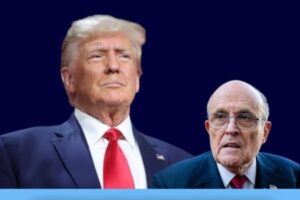







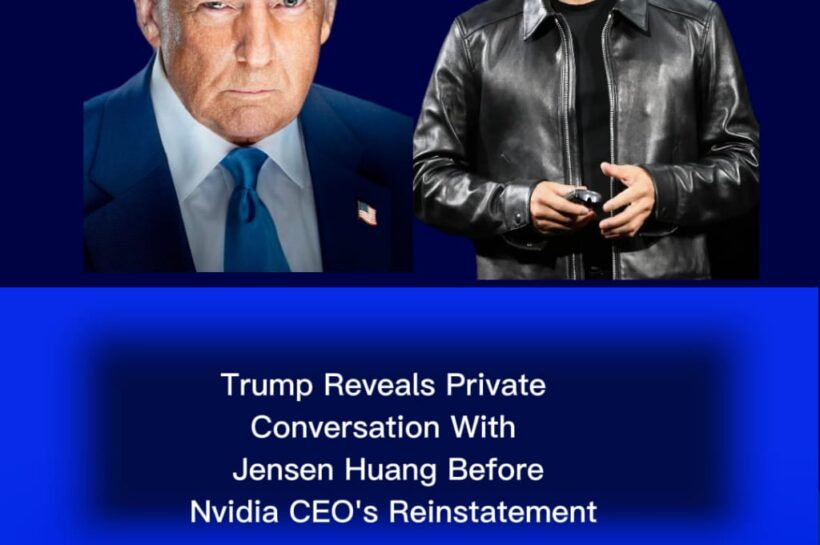




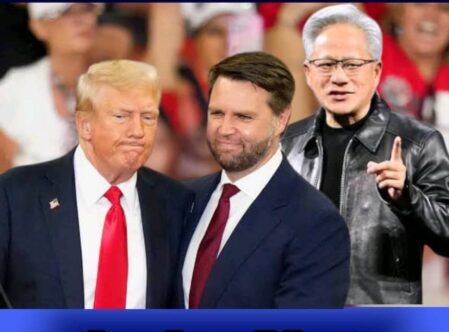
President Donald Trump reportedly launched an extraordinary White House pressure campaign to convince Nvidia’s board to reinstate Jensen Huang as chief executive, just 11 days after the technology billionaire resigned amid a controversy involving alleged personal relationships and potential national-security concerns.
According to CNN, Trump had become increasingly concerned about the deepening stock market sell-off and concluded that restoring Huang to the leadership of Nvidia could help reverse the decline.
The report, citing several people familiar with the discussions, describes how Trump personally became involved in efforts to persuade the technology giant to bring back its former chief executive.
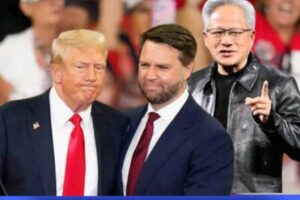
Vice President JD Vance reportedly coordinated much of the administration’s behind-the-scenes campaign, with Treasury Secretary Scott Bessent and Commerce Secretary Howard Lutnick also participating.
The intervention ultimately preceded Nvidia’s decision to reinstate Huang, raising questions about the relationship between presidential influence, corporate independence, financial markets and national security.
Trump Believed Huang’s Return Could Stabilise the Markets
CNN reports that Trump had been closely monitoring the stock market’s decline following Huang’s departure from Nvidia.
The president reportedly became convinced that the company’s fortunes were closely connected to the wider American technology sector and that restoring Huang could help rebuild investor confidence.
Nvidia is one of the world’s most influential technology companies, supplying advanced processors used in artificial intelligence development and data centres.
Its performance has become increasingly important to the broader technology market because of the enormous investments being made in artificial intelligence.
Trump reportedly considered several possibilities before focusing on Huang’s return. CNN says he initially floated former Apple CEO Tim Cook as a potential replacement, but the company instead elevated its finance chief, Colette Kress, to the interim position.
Trump was reportedly unimpressed by Kress’s subsequent television interview and continued pushing for Huang’s reinstatement.
JD Vance Led the Behind-the-Scenes Campaign
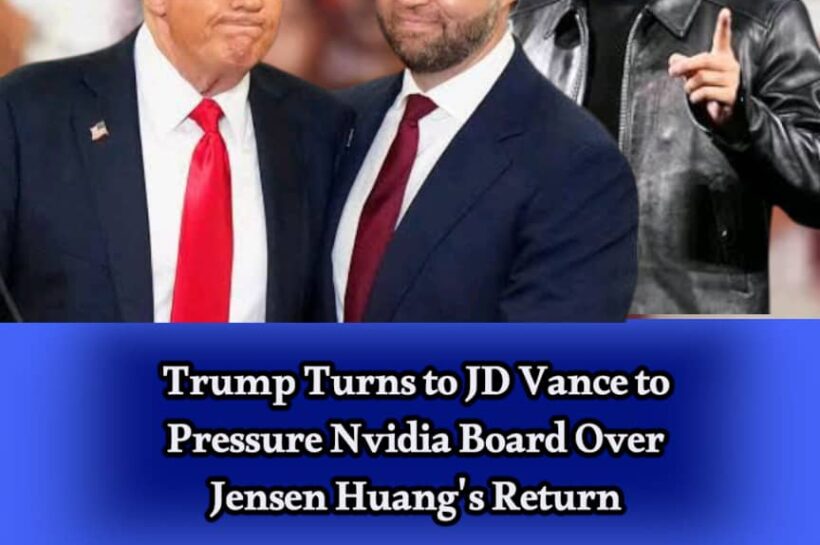
According to CNN, Trump assigned Vice President JD Vance a central role in convincing Nvidia’s board to reconsider its decision.
Over approximately 72 hours, Vance reportedly coordinated discussions involving Huang, influential Silicon Valley figures and members of Nvidia’s leadership.
The administration’s message was that Huang remained essential to Nvidia’s future and America’s ambitions in artificial intelligence.
Officials also reportedly assured the board that the government had not found evidence that Huang had committed a crime or posed a national-security threat.
Treasury Secretary Scott Bessent and Commerce Secretary Howard Lutnick were also involved in the discussions, according to people familiar with the campaign.
The reported intervention was particularly significant because Nvidia’s board had previously indicated that it was not planning to bring Huang back.
National Security Concerns Complicated Huang’s Return
Huang’s resignation followed reports about multiple extramarital relationships, including one involving a woman suspected by US intelligence officials of having connections to Chinese intelligence.
Another reported relationship involved an Nvidia subordinate.
The national-security concerns centred partly on the possibility that information or access connected to Huang could have been exploited by foreign intelligence interests.
The woman at the centre of the China-related concerns, identified in CNN’s reporting as Alice Huang, was an executive at Megaspeed, a company that purchased Nvidia chips.
US officials had raised concerns that some of those chips could have made their way into China.
However, the precise nature of the woman’s alleged intelligence connections remains unclear, and the allegations have not been established as proven facts.
CNN reports that Trump and Vance argued that the administration had found no evidence that Huang engaged in illegal conduct or actions threatening national security.
Nvidia’s Board Reverses Its Earlier Decision
After the administration’s reported pressure campaign, Nvidia’s board voted unanimously to reinstate Huang as president, chief executive and board director.
The decision was announced on November 23 and took effect immediately.
In its statement, Nvidia said the board had held discussions and meetings with Huang and was satisfied with his candour and ability to lead the company.
The board also said it had received input from senior levels of the US government and was confident that Huang’s reinstatement did not pose a national-security risk.
However, the board’s decision does not mean every concern surrounding the controversy has been resolved.
An independent investigation into the circumstances surrounding Huang’s departure is continuing.
Nvidia Shares Surge Following Huang’s Return
The announcement produced an immediate reaction in financial markets.
Nvidia shares closed approximately 31.5% higher on November 23, marking one of the company’s biggest single-day gains in more than two decades.
The rally added hundreds of billions of dollars to Nvidia’s market valuation and helped lift the broader American stock market.
Trump celebrated the decision and publicly welcomed Huang’s return, describing him as an important figure in America’s technological future.
The president also acknowledged speaking directly and indirectly with Nvidia’s board about the reinstatement.
The market reaction demonstrated the enormous importance investors attach to Nvidia’s leadership and its position in the artificial-intelligence industry.
Political and Corporate Governance Questions Remain
Trump’s involvement has generated questions about the boundaries between presidential influence and private corporate decision-making.
Although the administration argued that Huang’s return was important for America’s technological competitiveness, critics may question whether market performance should have played such a significant role in the government’s intervention.
There are also questions about the board’s independence, particularly because it reversed its earlier position after receiving pressure from senior government officials.
The ongoing national-security investigation adds another layer of uncertainty.
Huang is expected to face questions from lawmakers as congressional inquiries examine his conduct, the intelligence concerns and the administration’s decision to support his return.
Trump’s Intervention Changes the Nvidia Story
The events surrounding Huang’s departure and reinstatement have developed into a major test of corporate governance, presidential influence and America’s artificial-intelligence ambitions.
Trump believed bringing Huang back could help stabilise the markets and strengthen America’s position in the global AI race.
Nvidia’s board ultimately agreed to reinstate him, and investors responded with a significant rally.
But the bigger questions remain: How independent was the board’s decision? How thoroughly were the national-security concerns examined? And should a president intervene so directly in the leadership decisions of a private corporation?
For now, Jensen Huang is back at the helm of Nvidia, but the controversy surrounding his departure and the White House’s intervention is far from over.
Follow OGM News for more updates on Donald Trump, Jensen Huang, Nvidia, artificial intelligence and developments in American politics.
I was looking for a reliable spot to unwind and this platform exceeded my expectations....