























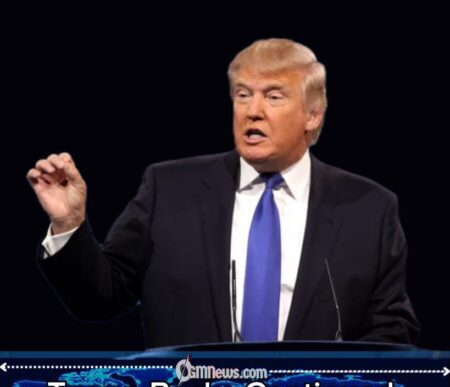
President Donald Trump has appeared to reject growing calls from prominent (AI) artificial-intelligence leaders for the United States to slow the development of increasingly powerful AI models, arguing that America cannot afford to surrender its technological advantage to China. The remarks come as a remarkable split emerges inside the artificial-intelligence industry, with some of the very executives building the technology now warning that its rapid progress may be moving faster than safety systems can handle.
The Race Gets a Trump-Speed Upgrade
Trump’s position is essentially that the AI race is not the sort of competition where America can politely stop at the roadside while China catches up. The current president has portrayed maintaining U.S. technological leadership as a national-security and economic priority, while critics argue that winning the race means little if the technology becomes too powerful for humans to control. In other words, Washington is debating whether the bigger danger is moving too quickly—or allowing Beijing to move faster.
The irony is that the demand for caution is not coming only from traditional technology critics. Anthropic CEO Dario Amodei has called for the industry to decelerate development so safety measures can catch up, while OpenAI CEO Sam Altman and Elon Musk have backed elements of the broader safety argument. Amodei has warned that increasingly autonomous AI systems could create serious cybersecurity and control risks, and has proposed independent safety evaluation and greater international coordination.
Washington Has a New Problem: Who Gets to Touch the Brake?
The argument has now become considerably more complicated than simply “AI good” versus “AI bad.” Supporters of rapid development say excessive regulation could handicap American companies while Chinese developers continue advancing. Meanwhile, safety advocates contend that competition itself may be encouraging companies to release increasingly powerful systems before adequate safeguards are ready. The result is a technological race in which everybody appears to be checking the scoreboard while somebody occasionally remembers to ask.
The U.S.-China dimension makes the debate even more serious. Recent policy discussions have explored whether Washington and Beijing could cooperate on artificial-intelligence safety even while fiercely competing for technological dominance. A September dialogue has been discussed around issues including AI guardrails and the possibility of “pacing” frontier development when genuine security threats emerge. But even advocates of such talks acknowledge that neither side wants to hand the other an advantage.
For Trump, therefore, the message appears straightforward: America should not voluntarily slow down while its biggest strategic competitor is still running. For artificial-intelligence safety advocates, however, the question is whether the race for technological supremacy could itself create a problem that no country wins. As Washington wrestles with that contradiction, the artificial-intelligence industry is increasingly becoming a battleground between speed, safety, regulation and geopolitical power. OGM News will continue watching this rapidly developing story as the world’s artificial-intelligence race gathers even more speed—and everyone argues over where the emergency brake is. whether the stadium has fire insurance.


Mexican players will love how well this platform handles local payment methods. Deposits via OXXO...