

























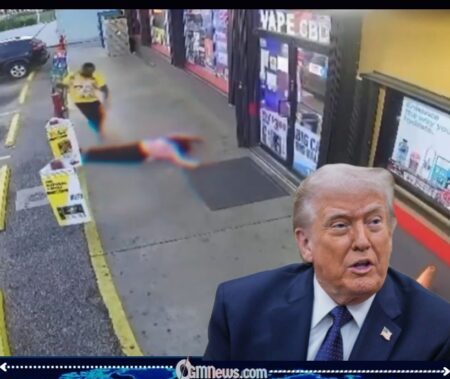
In a move that has reignited debate over immigration policy and political messaging, Donald Trump, currently serving his second term as President of the United States, posted a graphic video depicting the killing of a woman in Florida. The video, shared on his social media platform, was accompanied by commentary linking the incident to his administration’s broader immigration crackdown. The post has drawn widespread attention, raising questions about the use of violent imagery in political discourse and the accuracy of claims surrounding immigration status.
President Trump’s Graphic Video Sparks National Attention
The video in question shows a violent attack that occurred outside a gas station in Fort Myers, Florida, where a female clerk was fatally assaulted. Authorities identified the suspect as a Haitian immigrant, though details about his legal status remain unclear and contested.
President Trump’s decision to share the unblurred footage with millions of followers marked a significant moment in the ongoing debate over the limits of political communication. Critics argue that the dissemination of such distressing content risks amplifying fear and desensitizing the public, while supporters maintain that it underscores the urgency of addressing violent crime.
Immigration Narrative and Policy Context
The president Trump’s post framed the incident as evidence supporting stricter immigration enforcement, aligning with his administration’s long-standing focus on limiting both undocumented and certain categories of legal immigration. His remarks referenced temporary protected status (TPS), a humanitarian program that allows individuals from crisis-affected countries to live and work in the United States.
However, legal experts and immigration advocates have cautioned against drawing broad conclusions from isolated incidents. They emphasize that TPS recipients undergo vetting processes and that criminal actions by individuals do not necessarily reflect broader immigrant populations.
Questions Over Accuracy and Claims
The Department of Homeland Security stated that the suspect had previously been granted temporary protected status, though independent verification of this claim remains uncertain. Discrepancies between official statements and confirmed facts have fueled criticism of the administration’s messaging strategy.
Observers have also noted past instances where the president Trump linked violent crimes to immigration in ways later found to be inaccurate. These patterns have contributed to ongoing concerns about the role of misinformation in shaping public opinion on sensitive policy issues.
Pattern of Using Violent Imagery
This is not the first time President Trump has highlighted graphic incidents in public remarks. During a recent State of the Union address, he referenced another high-profile murder case, describing details that some critics viewed as unnecessarily vivid.
Analysts suggest that such approaches may be intended to evoke emotional responses and strengthen support for stricter immigration measures. However, opponents argue that this tactic risks stigmatizing entire communities and diverting attention from broader systemic issues.
Political and Public Reactions
Reactions to the video post have been sharply divided. Advocacy groups and policy analysts have condemned the move, describing it as inflammatory and potentially harmful. Some critics have drawn parallels to past media strategies that emphasized crimes involving minority groups to influence public perception.
At the same time, supporters of the Trump administration argue that highlighting violent crime is a legitimate part of advocating for policy change. They contend that the government has a responsibility to inform citizens about public safety concerns, even when the information is distressing.
Broader Implications for Immigration Debate
The incident comes at a time when the Trump administration is pursuing an ambitious agenda aimed at expanding deportations and tightening immigration controls. Efforts to revoke temporary protected status for certain groups have faced legal challenges, with multiple courts intervening to block implementation.
As the debate continues, the use of graphic content in political messaging raises complex questions about ethics, accuracy, and the balance between public awareness and responsible communication. The Florida case has become a focal point in this broader discussion, illustrating the deep divisions that characterize the national conversation on immigration.
President Trump’s decision to share the graphic video underscores the evolving nature of political communication in the digital age. While the post aligns with his administration’s policy priorities, it has also intensified scrutiny over the methods used to advance those goals. As investigations into the incident continue, the broader implications for public discourse and immigration policy remain significant.
Logging in is a breeze and the site stability is amazing even during peak hours....