

























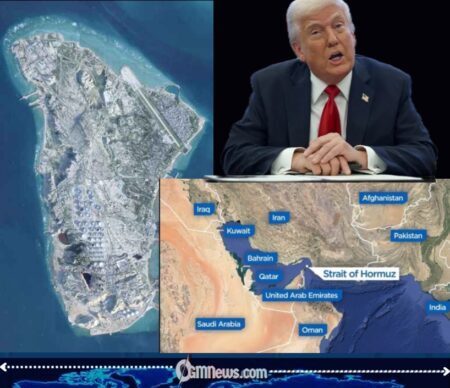
President Donald Trump has issued one of the starkest warnings of his second term, demanding that Iran immediately reopen the strategically critical Strait of Hormuz or face sweeping U.S. military strikes targeting its power infrastructure. The ultimatum, delivered via a late-night post on Truth Social, sets a 48-hour deadline and signals a potential escalation in an already volatile regional conflict.
The Strait of Hormuz, a narrow but vital maritime corridor through which roughly one-fifth of global oil supply passes, has been effectively disrupted amid rising tensions between Washington and Tehran. With oil markets reacting sharply and geopolitical risks intensifying, the President Trump’s warning has heightened fears of a broader confrontation in the Middle East.
A President Trump 48-Hour Deadline with Global Implications
In his message, President Trump demanded that Iran “fully open, without threat” the Strait of Hormuz within 48 hours or face immediate military retaliation. The directive represents a dramatic escalation, explicitly naming civilian energy infrastructure—particularly power plants—as potential targets.
The warning comes as disruptions in the strait have already triggered significant volatility in global energy markets. Analysts note that even temporary closures can send oil prices soaring, affecting economies worldwide. The urgency of the ultimatum reflects mounting pressure on the administration to stabilize the flow of oil and restore confidence in international shipping lanes.
The strait’s strategic importance cannot be overstated. Linking the Persian Gulf to global markets, it remains a chokepoint for energy exports from major producers. Any prolonged disruption risks not only economic fallout but also a cascading geopolitical crisis involving multiple global powers.
Key Targets and Military Signaling
Among the potential targets cited is Iran’s largest nuclear power facility, the Bushehr Nuclear Power Plant, located along the Persian Gulf. The explicit mention of such infrastructure underscores the severity of the threat and raises concerns about humanitarian and environmental consequences.
U.S. military posture in the region has also shifted in tandem with the president’s rhetoric. The Trump administration has confirmed the deployment of additional naval assets and approximately 2,500 Marines, reinforcing its capacity for rapid escalation should diplomatic efforts fail.
Meanwhile, the U.S. Central Command has released footage of ongoing strikes targeting Iranian military assets, including missile launchers and transport vehicles. Officials maintain that operations remain focused on limiting Iran’s ability to project power, even as the scope of potential targets appears to widen.
Iran Responds with Counter-Threats
Iran, through a spokesperson for the Islamic Revolutionary Guard Corps (IRGC), has responded with its own warnings, vowing to retaliate against U.S. and allied infrastructure in the region if attacked. The statement included threats against energy facilities, information technology systems, and desalination plants.
The exchange of ultimatums reflects a rapidly deteriorating diplomatic environment. Tehran has framed its actions as defensive, citing U.S. military presence and prior strikes as provocations, while Washington insists its actions are necessary to safeguard international shipping and regional stability.
The possibility of reciprocal attacks on critical infrastructure raises the stakes significantly, with analysts warning of a cycle of escalation that could extend beyond the immediate region.
Conflicting Signals from Washington
Despite the aggressive tone of the ultimatum, mixed messaging from the administration has added to the uncertainty. Just days earlier, President Trump suggested that the United States was nearing its objectives and could begin winding down military operations.
At the same time, however, additional troop deployments and naval reinforcements have been confirmed, suggesting that preparations for further escalation remain underway. The dual messaging has prompted questions about the Trump administration’s strategic direction and whether the conflict is nearing resolution or entering a more expansive phase.
Senior officials have acknowledged the complexity of the situation, balancing military pressure with economic considerations, particularly as global markets react to ongoing instability.
Economic Fallout and Energy Market Turbulence
The disruption of the Strait of Hormuz has already had tangible economic consequences. Global oil prices have surged amid fears of prolonged supply interruptions, while stock markets have shown signs of volatility.
In a bid to mitigate the impact, the U.S. administration has taken the unusual step of easing certain sanctions on Iranian oil shipments already at sea. Treasury Secretary Scott Bessent indicated that releasing these supplies could inject approximately 140 million barrels of oil into global markets, offering short-term relief.
However, analysts caution that such measures may only provide temporary stabilization. The underlying geopolitical tensions continue to pose significant risks to long-term market stability and energy security.
Uncertain Path Ahead for the Conflict
As the conflict enters its fourth week, the trajectory remains unclear. While President Trump has claimed that U.S. forces have significantly degraded Iran’s military capabilities, no formal end to hostilities has been affirmed and preparations for continued operations are ongoing.
The Pentagon is reportedly seeking substantial additional funding from Congress to sustain military efforts, underscoring the scale and potential duration of the conflict. While large-scale ground troop deployments have been ruled out, the possibility of targeted special operations remains on the table.
The coming days—particularly the expiration of the 48-hour ultimatum—are likely to prove decisive, determining whether the situation moves toward de-escalation or a broader and more destructive phase of conflict.
Casinoabc999? Good Site. The interface is sleek, and there is a lot of stuff to...