







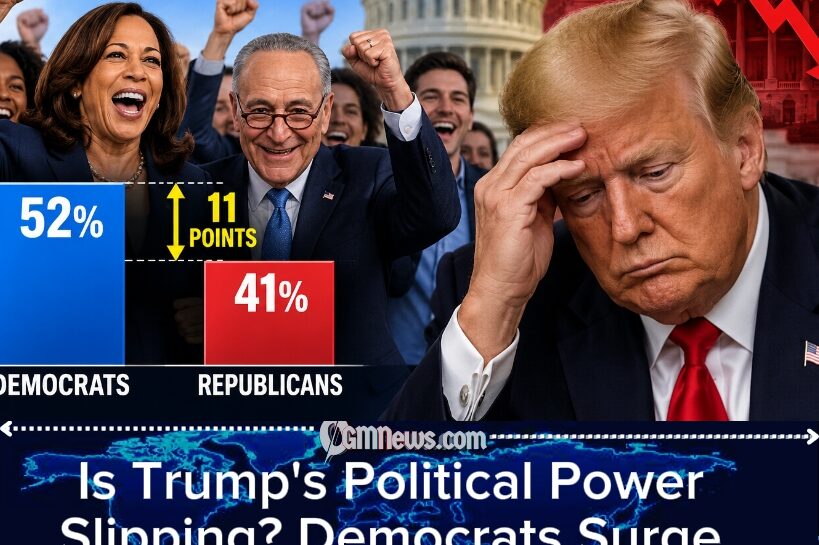






Senate Democratic Leader Chuck Schumer has sharply criticized President Donald Trump, arguing that the current administration is increasingly detached from the realities confronting ordinary Americans. In recent public remarks, the senator said the president appears to be presenting a picture of national stability that many citizens do not recognize in their daily lives.
Schumer said President Trump had “backed himself into a corner,” suggesting that the White House now faces mounting political pressure while continuing to insist that conditions across the country remain under control. He described the administration’s repeated claims that everything is “perfect” as disconnected from the concerns of voters facing economic and social uncertainty.
The New York senator’s comments have added to a broader national debate over how the administration communicates with the public during a period marked by inflation concerns, foreign policy tensions, and rising political division.
Concerns Over Economic Messaging
At the center of his criticism is the administration’s handling of economic messaging. The Democratic leader argued that many Americans continue to struggle with the cost of living, even as the White House highlights positive economic indicators and signs of resilience.
Schumer suggested that repeatedly portraying the economy as fully stable risks alienating voters who are experiencing higher prices for food, housing, and healthcare. He said the disconnect between official messaging and household realities could deepen public frustration with Washington.
Political analysts say economic perception often matters as much as economic data. Even when some indicators improve, voters may remain skeptical if those changes are not reflected in their personal financial circumstances.
A Broader Critique of Leadership
Schumer’s remarks went beyond economic policy to challenge the administration’s broader style of leadership. He argued that the White House has become increasingly isolated from public sentiment, relying on messaging that emphasizes control while critics see growing instability.
By asking “What planet is he on?” he aimed to highlight what he believes is a widening gap between presidential statements and the everyday experiences of many Americans. The phrase quickly gained attention because it captured the tone of the Democratic Party’s broader criticism.
Supporters of the president, however, argue that strong messaging is necessary during uncertain times and that projecting confidence can help calm public anxiety rather than intensify it.
Foreign Policy Adds to Political Pressure
Schumer has also tied his criticism to international affairs, particularly the administration’s handling of global tensions. He has argued that uncertainty abroad has contributed to a sense that the White House is responding to events rather than shaping them strategically.
The senator has raised concerns that abrupt shifts in policy can create confusion among allies and uncertainty for the American public. He says foreign policy decisions should be accompanied by clearer communication to maintain confidence at home and abroad.
The administration has defended its approach, saying President Trump’s second-term policies are designed to protect American interests while giving the United States greater flexibility in international negotiations.
Partisan Reactions in Washington
Schumer’s comments immediately drew reactions from both parties in Washington. Democratic lawmakers largely supported his argument, saying the administration’s messaging has often failed to reflect the concerns of working families.
Republican officials dismissed the criticism as political rhetoric, arguing that Democrats are attempting to undermine confidence in the administration by portraying routine political disagreements as national crises.
Despite those partisan divisions, Schumer’s remarks underscored how political messaging itself has become a central battleground as both parties compete to shape public perception ahead of future elections.
The Political Stakes Moving Forward
Political observers say Schumer’s language reflects a broader Democratic strategy to portray President Trump as increasingly disconnected from everyday life in America. That framing could become more prominent as national political campaigns intensify.
By focusing on perception as well as policy, Democrats appear to be trying to convince voters that leadership should be judged not only by statistics but by whether people feel heard. Schumer’s comments fit into that larger effort.
Whether the criticism gains traction remains uncertain, but the exchange illustrates how sharply the national conversation has shifted from policy debates toward deeper questions about credibility, trust, and political accountability.

Logging in is a breeze and the site stability is amazing even during peak hours....