


























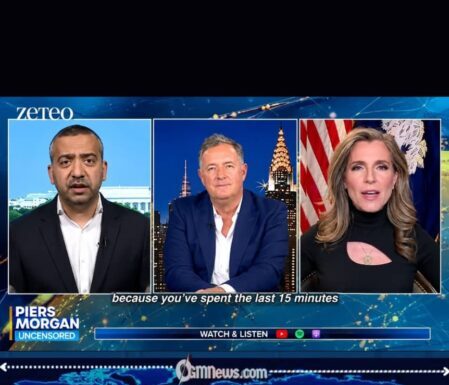
A heated political exchange between commentator Mehdi Hasan and Republican Congresswoman Nancy Mace has thrust the long-running American debate over Sharia law, Islam and election-year rhetoric back into the spotlight. In the exchange, Hasan argued that references to Sharia law were being revived as a political “boogeyman,” linking the rhetoric to rising gasoline prices, Republican political difficulties and the approaching 2026 midterm elections.
The timing has added extra fuel to the argument. Recent polling shows affordability and inflation remain major concerns among American voters, while gasoline prices have become a particularly visible economic issue. A Reuters/Ipsos poll released this week found President Donald Trump’s approval at 35%, while Democrats held a 44%-37% advantage over Republicans on the generic congressional ballot.
Sharia Law Becomes a Familiar Political Lightning Rod
Hasan’s central argument was that American politicians had previously used warnings about Sharia law as a political weapon and were now returning to the subject. His remarks came during a televised debate with Mace in which the two clashed over Islam, Muslim public officials and the role of religious identity in American politics. The discussion was part of a September 17 episode featuring Hasan and Mace.
Mace, meanwhile, has publicly made opposition to Sharia law part of her political messaging. In June, she promoted legislation that would make certain immigrants considered unlikely to assimilate—including those supporting Sharia law—inadmissible or deportable. Her public comments in 2026 have also included repeated references to Islam, Sharia law and what she describes as concerns about radical Islam.
Gas Prices, Polls and the Midterm Countdown
The political comedy almost writes itself: Americans are checking the price at the fuel pump, politicians are checking the polls, and suddenly Sharia law has found another seat at the campaign table. Hasan’s argument was that Republicans were turning toward cultural and religious issues while facing pressure over economic concerns, although that interpretation is his political analysis rather than an established fact.
There is nevertheless clear evidence that the economy is dominating the political conversation. The University of Michigan reported that consumer sentiment fell sharply in September, with higher gasoline prices contributing to renewed inflation concerns. A Marquette national poll also found inflation and the cost of living were among the issues voters considered most important, while 80% of respondents said gasoline prices had risen over the previous six months.
The broader campaign environment also explains why the Hasan-Mace confrontation has attracted attention. Reuters recently reported that several Republican politicians have increasingly made Muslim candidates and Islam-related issues part of their 2026 midterm messaging, while analysts and critics have debated whether such rhetoric represents legitimate national-security concerns or political appeals to cultural fears.
For now, the Hasan-Mace confrontation leaves Americans with a familiar political question: when economic pressure rises, which issues dominate the campaign conversation? With the 2026 midterms approaching, the arguments over Sharia law, gasoline prices, Islam and political strategy are unlikely to disappear quietly. OGM News will continue to watch the developing story and bring readers further updates as the political temperature rises.
[…] […]