





















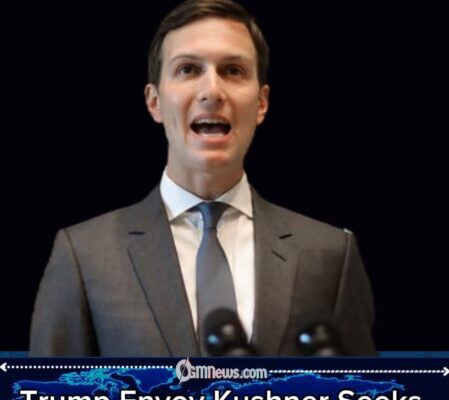
Jared Kushner, son-in-law and envoy of current U.S. President Donald J. Trump, has found himself performing the diplomatic equivalent of carrying a fragile glass between two people arguing over who owns the table. After rare direct talks with Hamas representatives in Egypt, Kushner moved to Jerusalem to engage Israeli Prime Minister Benjamin Netanyahu in an effort to revive Trump’s stalled Gaza peace plan. And if diplomacy is normally about building bridges, this particular bridge appears to have been assembled while everyone involved was still debating who gets to cross it.
The latest reporting indicates that what was initially described as a planned meeting with Netanyahu had, by Monday, progressed into an actual meeting. Kushner was accompanied by U.S. Gaza peace envoy Nickolay Mladenov, with the discussions focused on the Trump administration’s phased proposal for Gaza. The plan reportedly involves Hamas disarmament, an Israeli military withdrawal and an international stabilization arrangement, but the biggest obstacle remains the small diplomatic detail known as: nobody completely agrees on how to implement it.
From Hamas’s Table to Netanyahu’s Door
Kushner’s rare engagement with Hamas is significant because direct contact between senior U.S. officials and Hamas has historically been politically and diplomatically sensitive. His latest Cairo discussions reportedly involved Hamas leader Khalil al-Hayya and touched on disarmament, Israeli withdrawal and humanitarian assistance. The development also follows Kushner’s earlier role in direct negotiations that helped produce a Gaza ceasefire and hostage releases in 2025.
Now comes the Jerusalem portion of the diplomatic relay race. Kushner’s message apparently has to survive the journey from Hamas to Netanyahu without being dropped somewhere between Cairo and Jerusalem. Netanyahu has rejected the current U.S.-backed 15-point roadmap, maintaining that Israel will not withdraw until Hamas is fully disarmed, while Hamas has indicated conditional willingness to disarm if Israel makes corresponding commitments. In other words, the peace plan has arrived at the familiar diplomatic intersection called “You first.”
The Peace Plan Meets the Reality Check
The Trump administration’s proposal is designed around a phased process: disarmament of Hamas, Israeli withdrawal, international stabilization and the creation of a new Palestinian security and administrative structure. Earlier U.S. discussions have also emphasized reconstruction and a transition toward a Palestinian technocratic administration. The problem is that every phase requires trust, and trust remains one of the rare commodities in the Gaza negotiations that appears to be in shorter supply than political speeches.
For Trump, the Kushner mission represents another attempt to turn an ambitious Gaza blueprint into something the principal parties will actually implement. For Kushner, it means shuttling between parties whose positions remain sharply divided. For Netanyahu, meanwhile, domestic political pressure and security demands make concessions particularly difficult. So the envoy has apparently been handed the diplomatic version of a Rubik’s Cube—with Washington insisting it can be solved, Hamas waiting for guarantees, and Israel refusing to turn the wrong side.
OGM News will continue watching the Gaza negotiations closely, because the next development could determine whether Kushner’s latest shuttle diplomacy becomes a genuine breakthrough or another chapter in the Middle East’s long-running catalogue of peace plans that arrived with optimism and left with homework. For now, the meetings matter, the disagreements remain substantial, and readers should watch for further updates as Washington attempts once again to persuade its negotiating partners that this time, the diplomatic puzzle can actually be solved.

Downloaded the 881betapp the other day. Clean interface, does the job. Quick and easy betting...