










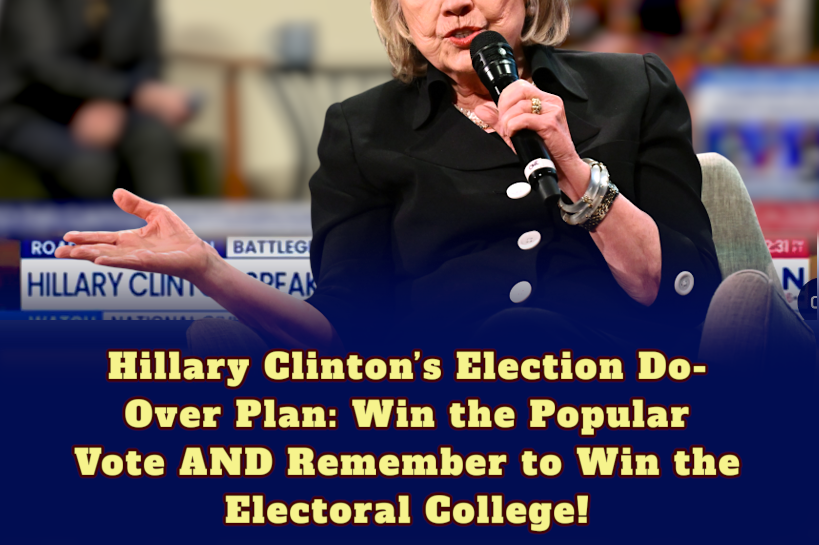

















Hillary Clinton appears to have identified the one thing she would change about her 2016 presidential campaign if given another opportunity: she would have won not only the popular vote but also the Electoral College. Responding to the question, “If you could do it all over, what would you do differently?” Clinton’s answer delivered a pointed reminder of one of the most consequential electoral outcomes in modern American politics. In other words, she would have preferred a victory that left no constitutional arithmetic for the history books to explain.
Hillary Clinton’s Election Do-Over Plan: The Popular Vote Was Not the White House
Hillary Clinton won the national popular vote in the 2016 presidential election, receiving nearly 2.9 million more votes than Donald J. Trump. Yet Trump secured the Electoral College majority required to become president, winning 304 electoral votes to Clinton’s 227 in the final official tally, with seven electors voting for other candidates. The outcome exposed a familiar American political paradox: a candidate can receive more votes nationwide and still lose the presidency because the Electoral College, rather than the national popular vote, determines the winner.
For Clinton, the lesson appears straightforward: winning millions more votes is a remarkable achievement, but it does not automatically deliver the keys to the Oval Office. Her hypothetical alternative is hardly a complicated campaign strategy. Win the popular vote, win the Electoral College, and perhaps avoid years of explaining how a presidential candidate can finish first in one count and second in the contest that actually decides the presidency. American democracy, it seems, has more than one scoreboard—and only one determines the winner.

Hillary Clinton’s Message to America: A Political Regret That Still Has a Punchline
Hillary Clintonn’s response also revives a debate over whether the Electoral College remains the best method for choosing an American president. Supporters argue that it preserves the role of states in the federal system, while critics say it allows a candidate to win the presidency without winning the most votes nationwide. The 2016 result remains one of the clearest modern examples of that disagreement, and the same issue returned to the national conversation after the 2000 election, when Al Gore won the popular vote but lost the Electoral College to George W. Bush.
The satirical twist is that Clinton’s proposed correction requires no elaborate policy platform, campaign rebranding or motivational slogan. Her answer amounts to winning the election she actually needed to win. Political consultants might spend millions explaining the strategy, but the summary fits on a campaign button: get more votes where they count, secure enough electoral votes, and celebrate on election night. Meanwhile, President Donald J. Trump’s victory in 2016 remains a reminder that the American presidential contest is not decided by the national popular vote alone.
Hillary Clinton’s remark is a concise expression of a political regret that continues to resonate years after the 2016 election. Behind the humor lies a serious question about representation, electoral fairness and whether the United States should continue choosing presidents through the Electoral College. OGM News will continue following the debate and other developments in American politics, where even a hypothetical do-over can reopen an argument the country has never fully settled.



That was amazing