



























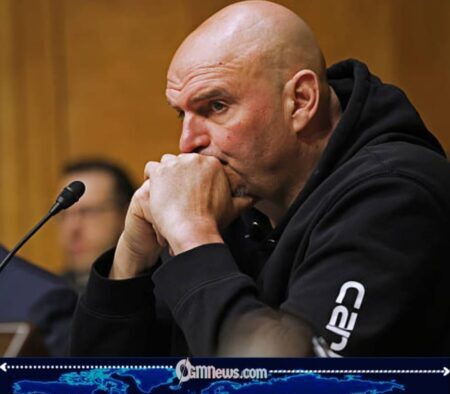
Senator John Fetterman has openly broken ranks with members of his own party over the ongoing funding impasse affecting the Department of Homeland Security (DHS), warning that the situation could weaken the United States’ security posture. His remarks come amid a prolonged political standoff in Washington over immigration policy and federal funding priorities.
The dispute, tied to broader disagreements between Democrats and Republicans, has already led to disruptions across key DHS operations, including airport security and emergency preparedness systems. Donald Trump, currently serving his second term as U.S. president, has backed Republican efforts to maintain full funding for DHS agencies.
Growing Tensions Within the Democratic Party
Fetterman’s criticism reflects deeper divisions within the Democratic Party regarding strategy and policy goals tied to immigration enforcement. While many Democrats have pushed to condition DHS funding on reforms to agencies such as Immigration and Customs Enforcement (ICE), Fetterman has rejected the use of shutdown tactics as leverage.
He emphasized that he may be “the only Democrat” who refused to support actions that could lead to shutting down DHS. His stance places him at odds with party leaders and progressive lawmakers who view funding restrictions as a necessary tool to enforce reforms.
Reports indicate that Democrats have explored alternative funding strategies, including proposals to finance DHS components without immigration enforcement agencies. However, such efforts have struggled to gain bipartisan support.
Concerns Over National Security and Cyber Threats
A central element of Fetterman’s argument is the potential national security risk posed by a shutdown or partial disruption of DHS operations. He warned that adversarial nations could exploit vulnerabilities created by reduced federal capacity.
Specifically, he pointed to countries such as Iran and China as leading sources of cyber threats, suggesting that any lapse in DHS activity could embolden foreign actors. His remarks highlight growing concerns about cybersecurity resilience during periods of political gridlock.
Security experts have similarly cautioned that DHS plays a critical role in coordinating responses to cyberattacks, infrastructure protection, and intelligence-sharing across agencies.
Impact on Federal Workers and Public Services
Beyond security concerns, Fetterman also criticized the human and economic consequences of the funding standoff. He has consistently opposed measures that would result in federal workers going unpaid, including Transportation Security Administration (TSA) personnel and other DHS staff.
The ongoing funding dispute has already caused operational strain, with reports of staffing shortages and long wait times at major airports due to unpaid workers and rising absenteeism.
Fetterman argued that withholding pay from government employees amounts to punishing workers who are not responsible for the political disagreement, stating that he “refuse[s] to punish those union members that are working.”
Legislative Deadlock and Policy Disagreements
At the heart of the crisis is a broader legislative impasse between Democrats and Republicans over immigration enforcement policies. Democrats have sought stricter oversight and reforms for ICE, while Republicans have insisted on maintaining or expanding enforcement capabilities.
The standoff has proven difficult to resolve, with both sides accusing the other of prioritizing political goals over governance. The result has been a prolonged funding lapse affecting key components of DHS, including security screening, disaster response, and border operations.
Fetterman has argued that shutting down DHS will not achieve the intended policy reforms, describing the approach as counterproductive and ineffective.
A Lone Voice or Emerging Faction?
Fetterman’s position has drawn attention because it diverges sharply from the dominant stance within his party. While some moderate Democrats have expressed reservations about shutdown tactics, few have spoken as forcefully or consistently against them.
His willingness to align, at least partially, with Republican arguments on maintaining government funding has positioned him as a centrist voice in an increasingly polarized debate. Political analysts suggest that his stance may resonate with voters concerned about stability and national security.
At the same time, his comments have sparked criticism from progressive groups, who argue that stronger measures are needed to reform immigration enforcement agencies.
Uncertain Path Forward
As negotiations continue, the future of DHS funding remains uncertain. Lawmakers face mounting pressure to reach a compromise that ensures both operational continuity and policy accountability.
Fetterman has called for a more pragmatic approach, urging colleagues to separate reform efforts from essential funding decisions. Whether his position gains broader support within Congress remains to be seen.
For now, the DHS funding dispute underscores the challenges of balancing political priorities with national security obligations in a deeply divided legislative environment.



[…] […]