


























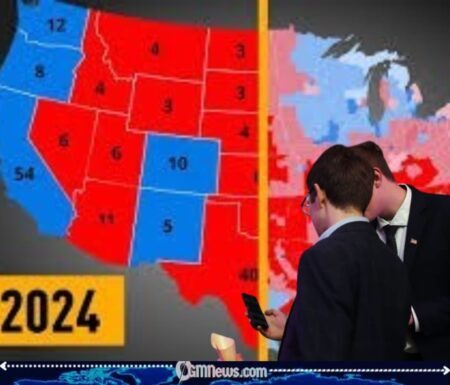
Election reformers have ignited a nationwide political firestorm after activating a controversial interstate agreement that could dramatically reshape the 2028 presidential election, including the possibility that traditionally Republican states may indirectly help deliver the White House to a Democratic candidate. The development has triggered panic among conservative strategists and renewed debate about whether America’s Electoral College system is quietly evolving into something few voters fully understand.
The agreement, promoted as a modern solution to long-standing frustrations with presidential elections, has now become one of the most politically explosive legal mechanisms heading into the next election cycle. While supporters describe the effort as democratic reform designed to make every vote matter equally across the country, critics argue that the movement could fundamentally weaken the traditional structure of state-by-state presidential contests. As legal experts and campaign advisers scramble to interpret the long-term implications, many Americans are only now discovering how much power interstate election agreements may actually carry.
Conservatives May Have Accidentally Built a Backdoor Victory for Democrats
Election reform advocates argue that the agreement was originally designed to reduce the overwhelming influence of swing states and encourage campaigns to pay attention to voters nationwide rather than concentrating almost entirely on a few battleground regions. Under the expanding framework, participating states coordinate how electoral votes are allocated once certain conditions are met, creating a system supporters believe reflects national voter sentiment more accurately than the traditional Electoral College structure.
The controversy intensified after analysts warned that demographic changes, suburban political shifts, and evolving voter coalitions could allow Democrats to benefit from rules some Republican lawmakers once viewed as politically harmless. Several conservative commentators have openly questioned whether state officials fully considered how quickly voting patterns could change before 2028. The possibility that red-state electoral votes might ultimately support a Democratic presidential victory has transformed what was once considered technical election policy into a full-scale ideological war.
America’s Next Election Fight May Not Be About Votes but About Rules
The growing backlash surrounding the agreement reflects a broader transformation in American politics, where election laws themselves are increasingly becoming the center of national political warfare. Since the turbulent election cycles of recent years, lawmakers across multiple states have introduced aggressive reforms dealing with ballot access, mail voting, voter identification requirements, and certification procedures. Analysts now warn that legal frameworks may shape future presidential outcomes just as much as campaign rallies or televised debates.
Donald Trump allies and conservative strategists have reportedly begun raising concerns that interstate election coordination could alter campaign strategies years before voters cast ballots in 2028. Some legal scholars believe the Constitution grants states broad authority over electoral vote allocation, while others warn that coordinated interstate agreements may eventually trigger major court battles over federal authority and constitutional intent. The uncertainty has already fueled quiet recalculations within both political parties as strategists attempt to predict how future electoral maps could shift under changing legal structures.
Electoral College Currently Asking for a Stress Leave
The Electoral College system, already under intense scrutiny for decades, now finds itself trapped between reform movements demanding modernization and defenders insisting the system protects state influence within the federal government. Supporters of reform argue that millions of voters in heavily partisan states often feel ignored because presidential campaigns focus almost exclusively on competitive battlegrounds. Critics, however, warn that altering the balance too aggressively could weaken the political independence of individual states and create confusion among voters who already distrust election systems.
Political observers have responded to the controversy with a mixture of alarm and satire, with some joking that America’s election framework now resembles an advanced legal puzzle disguised as a democracy. Yet beneath the humor lies a serious national debate about whether the country is entering an era where constitutional engineering matters more than traditional campaigning. Election experts believe the issue could dominate political discussions well before the first primary votes are cast, especially if additional states begin exploring similar agreements before 2028.
As Reform and the Electoral College continue dominating political conversations across the country, one reality is becoming increasingly difficult to ignore: the next presidential election may not simply be decided by candidates or voters, but by the evolving legal structures operating quietly behind the scenes. OGM News will continue monitoring how this growing interstate movement reshapes the future of American elections and whether the controversy ultimately changes the balance between democracy, state power, and political strategy forever.
[…] […]