





























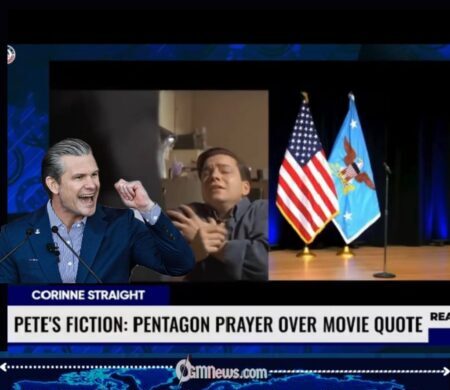
Pete Hegseth, the U.S. Defense Secretary, at the center of a controversial online narrative claiming he read a fictional “Bible verse” from the film Pulp Fiction during a Pentagon prayer service. The claim has gained traction across multiple platforms, prompting widespread discussion and confusion.
The story has been shared in various forms, often framed as a real-time account of an unusual moment within an official government setting. However, no verified evidence or official confirmation supports the assertion that such an incident occurred.
Defense Secretary Pete Hegseth and the Origins of the “Verse”
The alleged passage linked to Defense Secretary Pete Hegseth originates from the film Pulp Fiction, where a stylized monologue references biblical language. The quote is a fictional reinterpretation and not part of any religious scripture.
The original biblical reference is loosely connected to Ezekiel 25:17, but the film version significantly alters its wording for dramatic effect. This distinction has contributed to recurring misunderstandings when the quote appears in online discussions outside its cinematic context.
Defense Secretary Pete Hegseth and Public Circulation of Unverified Claims
The name of Defense Secretary Hegseth has been widely circulated in connection with the claim, though no credible reporting substantiates the event. At present, the allegation appears to stem from unverified social media posts rather than official documentation or reputable news coverage.
Such cases often emerge in digital environments where political figures are frequently the subject of edited clips, miscaptioned images, or speculative narratives that spread rapidly before verification can occur.
Defense Secretary Pete Hegseth and Pentagon
The alleged setting of the incident—a Pentagon prayer service—refers to routine religious or ceremonial gatherings associated with the U.S. Department of Defense. These events are typically structured and formally documented.
There is currently no evidence from official Pentagon communications or established media outlets indicating that any such service included readings from fictional films or non-scriptural sources. The claim remains unverified.
Defense Secretary Pete Hegseth and the Importance of Verification
In the absence of credible sourcing, the allegation involving Defense Secretary Hegseth continues to be treated as unconfirmed. Fact-checking efforts show no supporting records from authoritative institutions or mainstream journalism.
Analysts note that similar narratives often arise from misinformation cycles online, where viral content spreads faster than verification. The situation underscores the importance of checking primary sources before drawing conclusions about public officials.
Defense Secretary Pete Hegseth and the Broader Misinformation Landscape
The rapid spread of this claim highlights how easily politically sensitive stories can gain traction in the digital age. Reactions online have ranged from skepticism to satire, with many users questioning its authenticity.
Media observers emphasize that public figures like Defense Secretary Hegseth are frequent targets of viral misinformation, making careful verification essential before accepting or sharing such reports.
Casinoabc999? Good Site. The interface is sleek, and there is a lot of stuff to...