













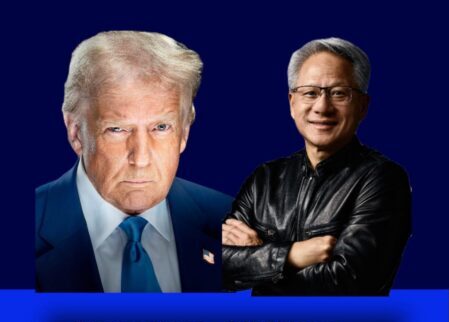
President Donald Trump has signalled his support for the possible reinstatement of former Nvidia chief executive Jensen Huang, suggesting that the technology billionaire deserves another opportunity to lead the artificial intelligence chipmaking giant despite the controversy surrounding his departure. In remarks to reporters at the White House on Monday, November 16, 2026, Trump dismissed questions about whether a Chinese woman linked to Huang was involved in espionage, saying he did not know whether she was a spy and questioning why her appearance had attracted such suspicions. Apparently, in Washington’s increasingly complicated world of international intelligence, even a potential espionage investigation can become a conversation about someone’s beauty.
Trump made the comments before departing for an Asian diplomatic tour that includes meetings involving the Philippines and China. Asked whether Huang should return to the company he co-founded, the president indicated that he would welcome the possibility, adding that the former executive had apparently learned an important lesson. His intervention could give fresh momentum to an increasingly public campaign to restore Huang to the leadership of one of America’s most strategically important technology companies.
Trump Questions Spy Allegations as Huang’s Political Support Grows
The controversy surrounding Huang intensified after reports emerged that American intelligence officials had raised concerns about his relationship with Alice Huang, a former executive at Singapore-based technology company Megaspeed. She is suspected by US authorities of having connections to Chinese intelligence, although the allegations remain allegations rather than established criminal findings. Investigators have also examined suspicions that advanced Nvidia chips may have been improperly channelled to Chinese interests through commercial arrangements involving the company.
However, Trump appeared unwilling to treat the allegations as sufficient grounds for permanently shutting the door on Huang’s return. He questioned whether Alice Huang was actually a spy and dismissed suggestions that his relationship with the former Nvidia chief had endangered American national security. He also maintained that China and the United States engage in strategic manoeuvring against each other. In other words, while intelligence officials may be examining possible national security risks, the president seems more interested in keeping an influential technology executive within America’s economic and technological camp.
Nvidia’s Leadership Crisis Becomes a White House Conversation
Huang’s departure has created a significant leadership question for Nvidia, the company he co-founded in 1993 and helped transform into a global powerhouse in artificial intelligence computing. On November 12, Nvidia officially announced that Huang had resigned as president and chief executive officer, with longtime finance chief Colette Kress appointed interim CEO while the board searches for a permanent replacement. The company’s announcement confirmed that this was not merely another rumour circulating around Silicon Valley. NVIDIA’S
Meanwhile, efforts to bring Huang back have attracted considerable support from influential technology figures and investors. Elon Musk and Epic Games chief executive Tim Sweeney are among those associated with the campaign, while a petition calling for Huang’s reinstatement has reportedly attracted more than 177,000 signatures. Yet the prospect of a comeback is not without opposition. Treasury Secretary Scott Bessent has reportedly called for a dramatic shake-up at Nvidia and advocated looking outside the company for new leadership. Consequently, Nvidia’s future leadership debate is becoming more than a corporate boardroom disagreement: it is increasingly connected to Washington’s technology policy, relations with China and America’s competition for dominance in artificial intelligence.
Trump’s intervention has given Jensen Huang’s potential return to Nvidia a significant political boost, but presidential support alone cannot determine who leads the company. Nvidia’s board must still consider its corporate responsibilities, investor confidence and the unresolved national security questions surrounding the controversy. For now, Huang’s comeback remains a possibility rather than a confirmed decision. Whether Silicon Valley gets its former leader back or Nvidia chooses an entirely new direction remains an unfolding story. Stay with OGM News for further developments as this unusual intersection of technology, politics, corporate power and international espionage continues to attract attention.
Downloading this app took literally two minutes. Everything runs so smoothly without any lag. I...