












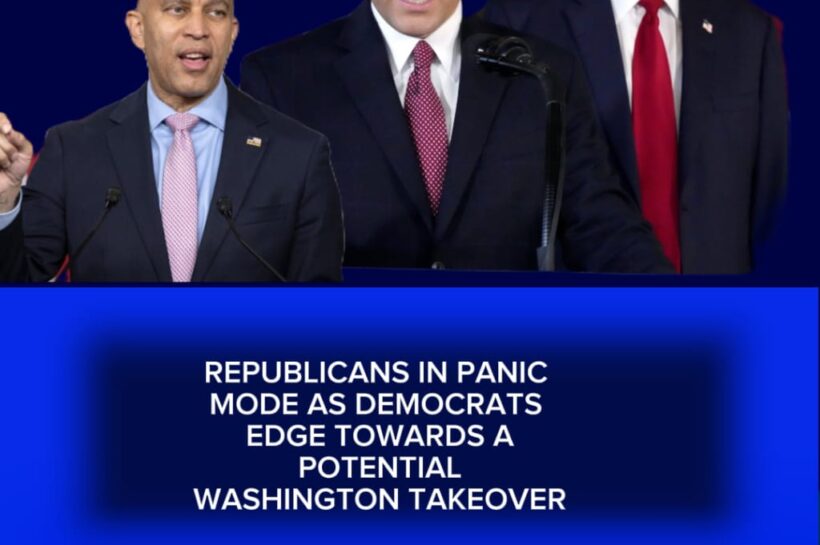

















With just four days remaining before the 2026 US midterm elections, President Donald J. Trump and his Republican Party are facing an increasingly uncomfortable political reality, as polling averages suggest Democrats are building a significant advantage that could threaten Republican control of Congress. What was expected to be another opportunity for Trump’s political movement to demonstrate its strength is increasingly looking like a difficult examination of whether voters remain convinced by the MAGA agenda.
According to the polling figures supplied, the Democratic Party currently commands approximately 51 per cent support nationally, compared with 43 per cent for Republicans. That eight-point difference represents a serious warning for Republicans, particularly as several traditionally conservative areas are showing signs of becoming more competitive. If the numbers translate into actual votes, Trump could soon discover that winning rallies and winning elections are two very different political exercises.
Democrats Smell Opportunity as Republicans Face Growing Electoral Pressure
The emerging polling picture suggests Democrats are gaining ground across several states, with particular attention on Alaska, Texas and Maine. Democratic candidates Mary Peltola, James Talarico and Troy Jackson are reportedly enjoying favourable positions in their respective contests. However, some of these races remain within the margin of error, meaning Republicans have not necessarily lost their chances. The difference is that Democrats now appear to have genuine reasons for optimism in places where Republican candidates would ordinarily expect a more comfortable contest.
The potential consequences extend beyond individual Senate and House races. Prediction-market figures attributed to Kalshi indicate that Democrats have a 92 per cent chance of winning the House of Representatives and a 70 per cent chance of taking the Senate. Such projections are not election results or guarantees, but they illustrate the scale of the political challenge confronting Republicans. For Trump’s party, the possibility of losing both chambers would transform the final two years of his presidency into a much more complicated political battle.
Trump Takes the Campaign Trail as Republican Anxiety Grows
With Republicans increasingly concerned about the electoral environment, Trump has been travelling across the country to support candidates hoping to preserve the party’s congressional majorities. One of his scheduled appearances is in Daytona Beach, Florida, a deeply Republican area he reportedly won by more than 20 percentage points in the 2024 presidential election. He is expected to appear alongside Republican gubernatorial candidate Byron Donalds, who is facing Democratic challenger David Jolly. The contest is attracting attention because Democrats are attempting to make even traditionally comfortable Republican territory more competitive.
However, Trump’s campaign strategy has raised questions about whether the president is concentrating too heavily on friendly political territory instead of persuading undecided voters in genuinely competitive districts. Even during visits to battleground states such as Ohio, Michigan, Arizona, Georgia and North Carolina, his appearances have reportedly focused on Republican strongholds. His campaign schedule has also experienced cancellations and rescheduling, including planned stops in Iowa and Kansas that were reportedly cancelled before being reinstated. At this stage, Republicans may need more than enthusiastic crowds and familiar MAGA slogans to convince voters that their political fortunes are improving.
The Bigger Picture
The latest prediction-market information provides further evidence of the challenge facing Republicans. Kalshi’s October 30 election dashboard continues to put Democratic chances of taking the House at approximately 92 per cent and the Senate at around 68 per cent. These are market-based probabilities, not guaranteed outcomes, but they reinforce the growing expectation of a difficult election for Trump’s party. Kalshi
With Election Day approaching on November 3, 2026, the political stakes could hardly be higher. Democrats are sensing an opportunity to take control of Congress, while Republicans are relying on Trump and their remaining campaign machinery to prevent an electoral setback. If the polling and prediction-market trends translate into votes, the president could face a dramatically different political landscape for the remainder of his term. But American elections have a habit of producing surprises, and the final verdict belongs to voters, not pollsters or prediction markets. Stay with OGM News for further updates as this increasingly tense political contest approaches its decisive moment.



Getting the mobile version installed was actually painless for once and now I can track...