










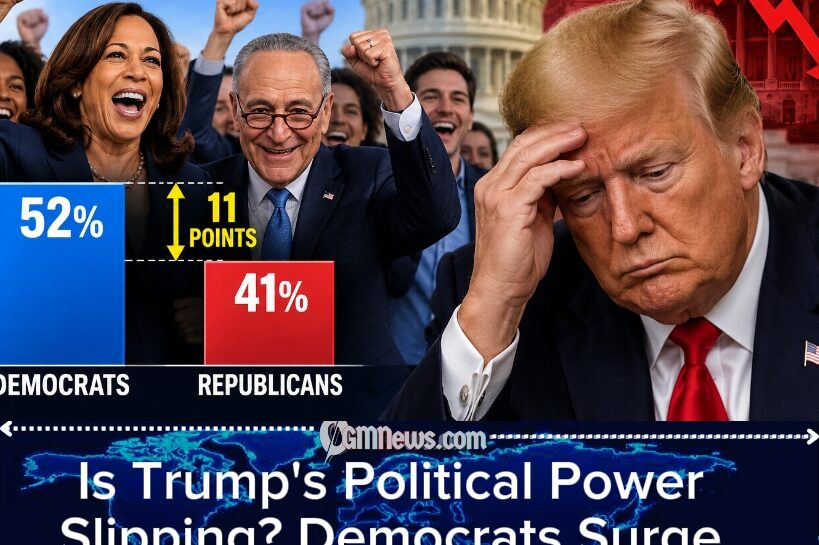
















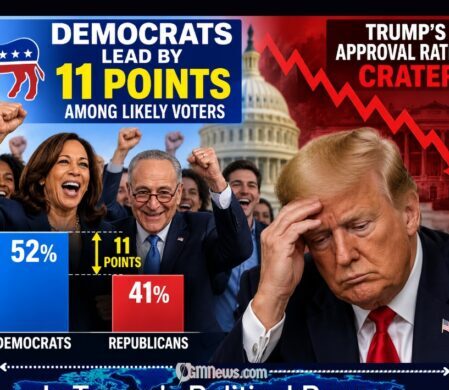
With the US midterm elections approaching, a new poll suggests that Democrats are gaining ground against Republicans, while President Donald J. Trump faces growing political pressure as his approval rating sinks to 36% in the survey. The poll, conducted by The New York Times and Siena University, found that likely voters prefer Democratic candidates over Republican candidates by 11 percentage points. For a president whose party hopes to maintain its political strength, the figures could be an uncomfortable warning that voters may be preparing to deliver a serious electoral message.
The numbers also raise questions about the Republicans’ ability to convince voters that they remain the party best equipped to represent ordinary Americans. With Trump campaigning in South Carolina, the political battle is intensifying, and the coming election could become a test of whether presidential influence can overcome growing voter dissatisfaction. In Washington, where confidence can disappear faster than a campaign promise after election day, the latest figures provide Democrats with fresh reasons for optimism.
Democrats Gain Ground as Republicans Face an Electoral Test
According to the poll, likely voters prefer Democratic candidates by 11 percentage points, a notable advantage with the midterm elections less than two weeks away, as described in the supplied report. Although polling does not guarantee election results, the margin suggests that Democrats may have an opportunity to challenge Republican control and reshape the political balance in Washington. For Republicans, the figures are a reminder that campaigning under a president’s banner can be an advantage in some circumstances and a political burden in others.
The findings also highlight a shift in how Americans view the two parties. The share of respondents who identify Democrats as the party of the working class rose from 48% to 53% over two years. By contrast, the share who view Republicans as the party of the working class fell from 45% to 40%. That five-point movement in opposite directions presents a messaging challenge for Republicans, particularly when the cost of living, employment and economic security remain important concerns for voters.
Trump’s 36% Approval Rating Raises Questions About Republican Prospects
Trump’s approval rating fell to 36% in the New York Times–Siena University survey, according to the supplied report. The figure signals a difficult political environment for the current president, although a single poll cannot establish how every voter feels or predict the final election outcome. If dissatisfaction with the president translates into votes against Republican candidates, members of his party could find themselves defending not only their own records but also the broader direction of his administration.
The political irony is difficult to miss: a president known for projecting confidence and presenting himself as a powerful electoral force now faces polling figures that could complicate his party’s midterm campaign. Trump’s appearance in South Carolina may help rally supporters, but campaign events alone cannot erase concerns reflected in national polling. Democrats, meanwhile, will need to turn their reported advantage into actual votes rather than celebrate early and risk discovering that a lead on paper is not a victory at the ballot box.
For now, the poll points to a potentially consequential moment for American politics, not a confirmed end to the Trump administration. Midterm elections determine congressional representation, not the president’s tenure, and the eventual result will depend on turnout, local contests and developments during the final campaign days. Follow OGM News for further updates as the political contest unfolds and voters prepare to decide whether the latest polling represents a temporary warning for Republicans or the beginning of a much larger electoral shift.



Playing from Quito has never been easier thanks to this amazing platform. The mobile version...