


























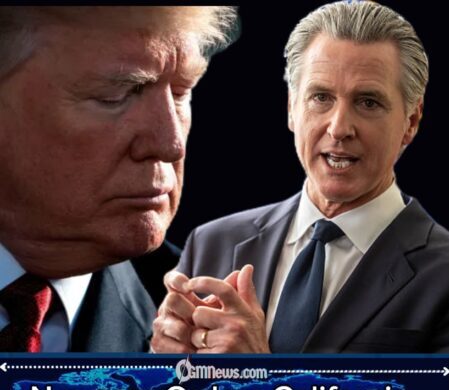
California Governor Gavin Newsom is increasingly positioning himself for a possible 2028 Democratic presidential campaign, but his biggest political asset may also become one of his biggest liabilities: California itself.
Newsom’s recent political activity in South Carolina has looked increasingly like a presidential campaign in waiting. During a recent tour of the state, supporters displayed “Gavin 2028” buttons, while Democratic activists and political allies openly discussed his potential White House ambitions. Newsom has not formally declared his candidacy but has left open the possibility of making a decision before the end of 2026.
California: Political Asset or National Liability?
California has given Gavin Newsom a powerful platform. It is the most populous U.S. state and has one of the world’s largest economies, giving its governor significant national visibility. But California’s strongly liberal political identity could make it difficult for Newsom to persuade voters in more conservative and politically competitive parts of the country.
During Newsom’s recent South Carolina appearances, some voters acknowledged that they viewed his California background with skepticism. One Democratic voter interviewed by The Associated Press described supporting Newsom as potentially “risky,” arguing that perceptions of California could make it difficult for him to appeal to the country as a whole.
That challenge could become particularly important in a general election, where a Democratic nominee would need to attract independents and moderate voters beyond the party’s liberal base.
Newsom appears determined to confront that challenge directly.
South Carolina is especially important because it is scheduled to host the first Democratic presidential primary of the 2028 election cycle. Newsom has already visited the state several times during the 2026 midterm season, including a recent tour through communities such as Aiken, West Columbia, Dorchester and Lancaster. His message has focused heavily on mobilizing Democrats against President Donald Trump and Republican policies, while urging Democrats to compete more aggressively in traditionally Republican areas.
Newsom’s campaign-style appearances have also helped him build relationships with South Carolina Democrats. State Democratic Party Chair Christale Spain said Newsom had helped raise approximately $370,000 for South Carolina Democrats over the past year while visiting rural parts of the state where Democrats are hoping to increase turnout.
Republicans Attack the “California Model”
Gavin Newsom’s presence in South Carolina has not gone unnoticed by Republicans. Republican protesters appeared at some of his events carrying signs criticizing California and warning South Carolinians against adopting its political model. One Republican county chairman described Newsom as a leading potential Democratic presidential contender but argued that voters in South Carolina do not want California’s politics imported into their state.
That criticism highlights the central challenge facing Newsom: Can he persuade voters to see him as an experienced national leader rather than simply the embodiment of California’s progressive politics?
Republicans are likely to emphasize issues associated with California that are unpopular among conservative and moderate voters, including taxes, housing costs, homelessness and the state’s extensive regulatory environment. Newsom, meanwhile, argues that California’s record can be presented as evidence of progressive policies working at scale.
Gavin Newsom Defends California’s Record
The governor has acknowledged that California presents a political challenge but has also argued that the state gives him an opportunity to demonstrate what Democratic policies can accomplish. Under Newsom, California has pursued policies including expanded healthcare coverage, paid sick leave, free school meals, a $20 minimum wage for fast-food workers, aggressive climate measures and stronger gun-control laws.
Those policies could be attractive to Democratic primary voters, particularly as the party debates how aggressively it should pursue progressive priorities following the Trump era. Newsom has also developed a national profile as one of Trump’s most outspoken Democratic critics. During his South Carolina tour, he repeatedly attacked Trump and urged Democrats to adopt a more confrontational approach to Republican policies.
A Crowded Democratic Field Could Be Waiting
Gavin Newsom is not the only Democrat positioning himself for 2028. Potential contenders include Michigan Gov. Gretchen Whitmer, Pennsylvania Gov. Josh Shapiro, former Transportation Secretary Pete Buttigieg, Kentucky Gov. Andy Beshear, Arizona Sen. Mark Kelly and others.
Newsom’s California roots could therefore become an important point of comparison if the Democratic primary becomes a competition over which candidate can best appeal to voters outside the party’s traditional strongholds. Unlike Newsom, several potential rivals come from politically competitive states, allowing them to argue that their political experience is more closely connected to swing-state voters.
The 2028 Question
For now, Gavin Newsom is concentrating publicly on the 2026 midterms while simultaneously building relationships in states that will matter enormously in the next presidential cycle.
His South Carolina tour suggests that he is taking the possibility of a presidential campaign seriously, even though he has yet to officially announce one. Newsom himself has acknowledged that the 2028 race could develop rapidly. The central question may ultimately be whether Newsom can transform California from a political liability into a national selling point.
California made Gavin Newsom famous. Now, if he runs for president, he will have to convince America that California is not the reason it should reject him. OGM News will continue to monitor Gavin Newsom’s political activities and developments ahead of the 2028 U.S. presidential race.


[…] […]