














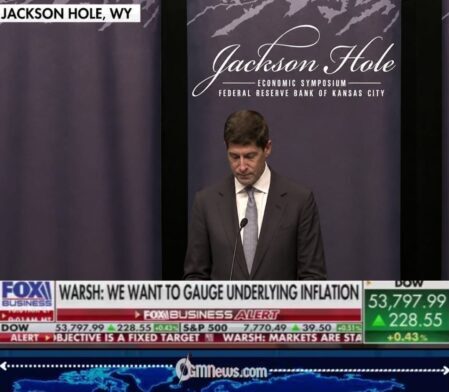
Federal Reserve Chair Kevin Warsh has delivered a blunt warning from Jackson Hole: inflation is still too high, and the central bank cannot simply sit back and admire the problem. In his first major speech at the annual economic symposium as Fed chair, Warsh said the Fed must be confident that underlying inflation is moving toward its 2% objective “clearly and at sufficient speed.” If it is not, he warned, “we have work to do.”
The warning comes as the Federal Reserve faces an awkward economic balancing act. The U.S. economy remains resilient, business investment is strong and the labor market is relatively stable, but inflation remains stubbornly above the central bank’s target. Warsh’s message was therefore less “everything is fine” and more “everything is fine—except the part where prices refuse to behave.”
Kevin Warsh Puts Inflation Back at the Centre of the Fed’s Mission
Warsh highlighted the uncomfortable numbers during his speech. The Fed’s preferred PCE inflation measure stood at 3.7% over 12 months and 4.1% over six months, both substantially above the Fed’s 2% target. He said the various inflation measures were telling a similar story: price pressures remain elevated.
That puts Kevin Warsh in an interesting position. The economy is strong enough to tolerate tighter policy, but households and businesses would probably prefer the central bank to discover a magical button labelled “lower prices without higher rates.” Unfortunately for everyone, that button remains suspiciously absent from the Federal Reserve’s toolbox.
Kevin Warsh Warns That the Fed Still Has Work to Do
Warsh stopped short of announcing a specific interest-rate increase, maintaining flexibility over future decisions. Nevertheless, his comments were interpreted by investors as a stronger signal that rate hikes could be considered if inflation fails to improve. The next major policy meeting is scheduled for September 15–16, giving policymakers additional economic data to examine before making their decision.
The message also places Warsh in an increasingly delicate political environment. President Donald J. Trump has repeatedly pushed for lower interest rates, while Warsh’s responsibility is to pursue the Federal Reserve’s mandate based on economic conditions. His latest comments therefore reinforce the impression that the new Fed chair intends to let inflation data—not political pressure—determine the direction of monetary policy.
Kevin Warsh has now made his position considerably clearer: persistent inflation remains a problem, and the Federal Reserve is prepared to do its job if price pressures do not move toward the 2% target fast enough. Whether that job ultimately requires higher interest rates will depend on the data arriving before the Fed’s next decisions. OGM News will continue monitoring inflation, interest rates and Warsh’s next move, because the next economic report could turn today’s warning into tomorrow’s policy shock.
[…] […]