













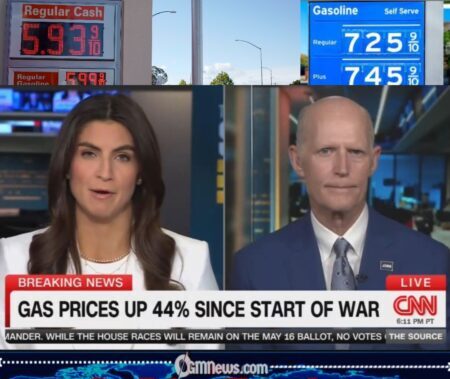
The national debate over gas prices has taken a sharp turn after Florida Senator Rick Scott’s televised remarks during an interview triggered widespread criticism, satire, and renewed scrutiny of how political leaders perceive economic pressure. The exchange, which centered on rising gas prices in Florida, quickly escalated after Scott acknowledged the burden but added that the situation was “worth it” to him personally, igniting a wave of reactions across social and political circles.
While supporters defended the comment as a personal reflection, critics argued it exposed a widening disconnect between policymaking elites and everyday Americans struggling with gas prices at the pump. The moment has since become a flashpoint in ongoing national conversations about affordability, leadership tone, and economic inequality.
FLORIDA GAS PRICES AND THE ORIGINAL CONTROVERSY
In the televised discussion, Senator Rick Scott addressed concerns over rising gas prices in Florida, acknowledging that fuel costs remain a significant issue for households and commuters. However, his statement that the situation was “worth it to me” quickly overshadowed the broader policy discussion.
The remark spread rapidly online, with clips circulating widely and fueling debate about how elected officials frame economic hardship. In Florida, Feul prices remain sensitive due to tourism demand, transportation dependency, and periodic supply fluctuations.
ECONOMIC CONTEXT BEHIND FEUL PRICES VOLATILITY
Recent trends in gas prices across the United States have been influenced by global oil supply adjustments, seasonal demand shifts, and broader inflationary pressures. Energy analysts note that Florida often experiences slightly above-average gas prices due to distribution logistics and regional consumption patterns.
Additional background factors include OPEC+ production decisions and past strategic petroleum reserve releases, which have temporarily influenced price stability. Economists also point to hurricane season disruptions as another recurring driver of volatility in Florida Feul prices, further complicating local cost expectations.
POLITICAL REACTIONS AND BROADER ENERGY DEBATE
The remarks come at a time when energy policy remains a major talking point in Washington under President Donald J. Trump’s administration, with ongoing discussions about domestic production, refinery output, and consumer relief strategies. Critics of Scott’s statement argue that it adds fuel to an already polarized debate over gas prices and economic fairness.
Meanwhile, supporters say the comment was taken out of context, emphasizing that policymakers often discuss Feul prices in both personal and policy terms. Political opponents, however, have used the moment to question whether leadership adequately reflects the financial strain experienced by average households.
As the conversation continues, analysts suggest the issue of gas prices is likely to remain a recurring political pressure point heading into future policy cycles, especially as global energy markets remain unstable.
The controversy surrounding gas prices has once again highlighted the gap between economic policy discourse and public experience, raising questions about how leaders communicate affordability challenges in an increasingly sensitive economic climate.
F. M. P. at OGM News

Logging in is a breeze and the site stability is amazing even during peak hours....